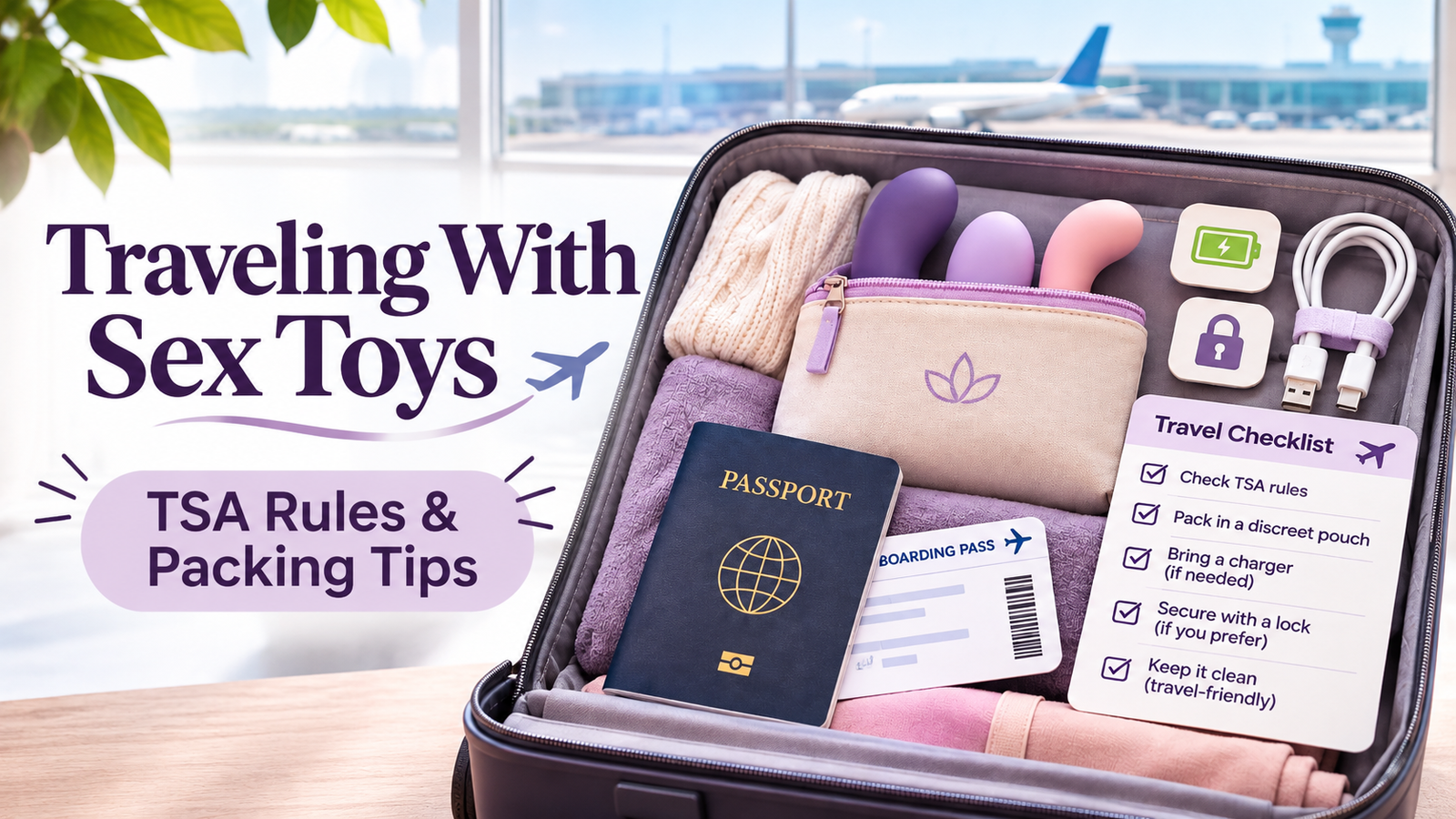
Traveling With Sex Toys: TSA Rules & Packing Tips
Traveling with sex toys can raise questions you may not have considered when using them at home. Can you bring a vibrator in your carry-on bag? What happens if airport security inspects it? And are rechargeable toys subject to different battery rules?
The good news is that traveling with sex toys is generally permitted under U.S. airport security rules. However, the answer becomes more complicated when batteries, liquids, and international customs regulations are involved.
This guide explains the TSA rules, how to identify your toy’s battery type, how to pack discreetly, and what to check before your next flight.
Quick Answer: Can You Bring Sex Toys on a Plane?
Yes. The U.S. Transportation Security Administration (TSA) generally allows adult toys in both carry-on and checked baggage.
However, battery restrictions still apply. Rechargeable toys with built-in lithium batteries are generally best packed in carry-on luggage, while spare lithium batteries and power banks must remain in the cabin.
International travelers must also check destination-country customs laws. A toy allowed through U.S. airport security may still be prohibited from entering another country.
The safest approach is to identify your toy’s battery type, prevent accidental activation, and verify the airline and destination rules before flying.
This guide focuses primarily on U.S. TSA and FAA rules, with additional guidance for international travel. Regulations and airline policies can change.
Can You Bring Sex Toys on a Plane?
Under the TSA’s published guidance, adult toys are generally permitted in both carry-on and checked baggage on flights departing from U.S. airports.
This includes many common products, such as vibrators, vibrating rings, and non-electronic personal intimacy products.
However, permission to bring an adult toy through security does not automatically mean every item is allowed without restrictions.
Three separate considerations matter:
- Airport security: TSA determines whether an item can pass through a U.S. security checkpoint.
- Battery safety: FAA regulations govern batteries and battery-powered devices transported on aircraft.
- Customs and local laws: Destination countries may restrict or prohibit certain adult products.
The TSA also retains authority to require additional screening or refuse an item that raises security concerns.
For current guidance, visit the official TSA Toys (Adult) page.
Carry-On vs. Checked Luggage: Where Should You Pack Your Toy?
Choosing between carry-on and checked baggage depends on the product’s battery type and design.
A simple battery-free product presents fewer airline battery-safety concerns than a rechargeable vibrator. Meanwhile, a product with removable batteries may require separate consideration of the batteries themselves.
The following table summarizes the general U.S. rules.
| Product or Battery Type | Carry-On | Checked Baggage |
|---|---|---|
| Battery-free sex toy | Generally allowed | Generally allowed |
| Installed lithium battery | Allowed within limits | Conditional: fully off and protected |
| Spare lithium-ion battery | Allowed within limits | Not allowed |
| Spare lithium coin battery | Allowed within limits | Not allowed |
| Alkaline AA, AAA, or LR44 | Allowed | Allowed |
| NiMH rechargeable battery | Allowed | Allowed |
| Power bank | Allowed within limits | Not allowed |
| Gel-filled toy | TSA liquids rules apply | Generally allowed |
General U.S. rules only. Restrictions, battery limits, screening decisions, and airline policies may affect what is permitted.
For most small rechargeable toys, carry-on luggage is the more practical choice. This follows the FAA’s general recommendation to keep lithium battery-powered electronic devices in the cabin.
However, it is incorrect to say that every rechargeable vibrator is prohibited in checked baggage.
The FAA permits many devices containing installed lithium batteries in checked baggage when the applicable requirements are satisfied, including complete shutdown and protection against damage or accidental activation.
Spare lithium batteries are different: they must be carried in the cabin.
If you are uncertain about your battery’s specifications, contact the manufacturer or airline rather than assuming that your device is permitted.
Battery Rules for Traveling With Sex Toys
Battery safety is one of the most important parts of planning a flight with an electronic sex toy.
Although many modern vibrators use rechargeable lithium-ion batteries, others use ordinary alkaline batteries, rechargeable nickel-metal hydride (NiMH) batteries, or disposable lithium coin cells.
These categories do not all follow the same transportation rules.
How to Identify Your Sex Toy’s Battery Type
Before packing, determine what kind of battery powers your product.
Step 1: Check the instruction manual
Look under headings such as “Battery,” “Power Supply,” “Technical Specifications,” or “Product Information.”
Common battery descriptions include:
- Li-ion or Lithium-ion: rechargeable lithium-ion battery
- Li-Po or Lithium Polymer: a type of rechargeable lithium-ion battery
- Alkaline: a disposable alkaline battery
- NiMH: a rechargeable nickel-metal hydride battery
- Lithium Metal: a non-rechargeable lithium battery
Step 2: Check the device and battery compartment
Some products display battery information directly on the body, the battery cover, or the original packaging.
For removable-battery products, check the markings on the actual batteries.
Useful examples include:
| Battery Marking | What It Commonly Indicates |
|---|---|
| LR44, 1.5V | Alkaline button cell |
| CR2032, 3V | Non-rechargeable lithium coin cell |
| AA or AAA marked Alkaline | Alkaline battery |
| AA or AAA marked NiMH, 1.2V | Rechargeable NiMH battery |
| Li-ion, 3.7V | Rechargeable lithium-ion battery |
| Li-Po, 3.7V | Rechargeable lithium-polymer battery |
Swipe horizontally to view the complete table on smaller screens.
Important: AA, AAA, and button-cell descriptions identify physical battery sizes or formats, not necessarily their chemistry. Always inspect the complete battery label.
Step 3: Do not assume USB charging identifies the battery
A product labeled “USB Rechargeable” may contain a lithium-ion battery, but the charging method alone does not confirm its chemistry.
Likewise, a “5V” marking may describe the USB input voltage rather than the internal battery voltage.
Step 4: Check the manufacturer’s official specifications
Search for the exact model name and number on the manufacturer’s website.
If necessary, contact customer support and ask:
“What type of battery does this product contain, and what is its watt-hour (Wh) rating?”
Step 5: Check accessories separately
Some remote-controlled toys include a rechargeable main device and a separate remote powered by a coin battery.
Charging cases and other accessories may contain additional batteries.
Check each component rather than assuming that the entire product uses a single battery type.
Never attempt to open a sealed rechargeable toy to identify its internal battery. Doing so may damage the battery, compromise waterproofing, or create a safety hazard.
Rechargeable Lithium-Ion Batteries
Rechargeable lithium-ion and lithium-polymer batteries are commonly used in compact electronic products.
Under the FAA’s general passenger rules, lithium-ion batteries rated at 100 watt-hours (Wh) or less are allowed within applicable conditions.
Larger batteries rated above 100 Wh and up to 160 Wh require airline approval. Devices or batteries exceeding the applicable limits may be prohibited.
These general capacity limits apply to lithium-ion batteries used in portable electronic devices.
For a toy containing an installed lithium battery:
- Carry-on baggage is recommended.
- If checked baggage is permitted, the device must be completely switched off and protected from accidental activation or damage.
- A travel lock can provide additional protection, but it is not a substitute for complete shutdown where required.
- Damaged, swollen, overheating, or recalled batteries require special attention and may be prohibited.
How to calculate battery capacity
If the manufacturer provides voltage and battery capacity but not watt-hours, use:
Wh = Voltage (V) × Capacity (mAh) ÷ 1,000
For example, a 3.7V battery rated at 1,000 mAh has a capacity of:
3.7 × 1,000 ÷ 1,000 = 3.7 Wh
Use the battery’s rated voltage and capacity, not simply the voltage printed next to a USB charging port.
If the required battery information is unavailable, request the specifications from the manufacturer.
For detailed rules, consult the FAA Airline Passengers and Batteries guide.
AA, AAA, and Button Cell Batteries
Not every battery-powered toy contains lithium.
Many products use removable alkaline AA or AAA batteries. Small vibrating rings and remote controls may use button cells.
The FAA generally permits conventional alkaline and NiMH dry batteries in both carry-on and checked baggage, provided they are protected from damage and short circuits.
However, button cells deserve closer attention.
For example:
- LR44 is commonly an alkaline button cell.
- CR2032 is a non-rechargeable lithium coin cell.
That distinction matters because spare lithium batteries must travel in carry-on baggage, while typical spare alkaline dry batteries may generally travel in either baggage category when properly protected.
Unlike rechargeable lithium-ion batteries, non-rechargeable lithium-metal batteries are subject to lithium-content limits rather than watt-hour limits. Under general FAA passenger rules, lithium-metal batteries are typically limited to 2 grams of lithium per battery. Check the battery’s specifications and any airline restrictions before traveling.
If your toy uses removable batteries, removing them can help prevent accidental activation. Store them in a protective battery case and follow the rules for their specific chemistry.
Spare Batteries and Power Banks
Under FAA rules, spare or uninstalled lithium-ion and lithium-metal batteries must remain in carry-on baggage.
This also applies to power banks.
Protect exposed battery terminals to prevent short circuits. Appropriate methods include individual battery cases, original packaging, or other protection recommended by the FAA.
If an airline requires you to check your carry-on at the gate, remove any spare lithium batteries and power banks before handing over the bag.
Always check your airline’s own rules, which may impose stricter limits.
How to Prevent Accidental Activation
An electronic toy turning on inside your luggage can be embarrassing, but unintended operation may also create a battery-safety concern.
Before leaving home:
- Switch the device off completely.
- Activate its travel-lock function if available.
- Remove removable batteries when practical.
- Use a protective case that prevents pressure on the controls.
- Check that the device cannot turn on accidentally while packed.
For products with non-removable lithium batteries in checked baggage, ensure the device meets the FAA’s full power-off and protective packing requirements.
Do not attempt to disable the battery by damaging, puncturing, or modifying the product.
How to Pack Sex Toys Discreetly for Travel
A little preparation can make traveling with personal products more comfortable and organized.
Use a Separate Storage Pouch
A clean fabric pouch or protective case keeps the product separate from clothing, toiletries, and other items.
For electronic toys, choose a case that protects buttons and charging connections.
A discreet case can help with privacy, but it does not prevent airport security from inspecting the contents.
Keep Accessories Organized
Store charging cables, compatible adapters, and manufacturer-approved accessories together.
If the product uses a proprietary charging cable, double-check that it is packed before leaving.
For remote-controlled devices, make sure the remote is switched off and its battery type has also been checked.
Avoid Unnecessary Bulk
For a short trip, consider bringing only the products you expect to use.
Compact, easy-to-clean designs can be simpler to pack than larger or more complicated products.
However, convenience should never take priority over proper battery handling or legal requirements.
What Happens If TSA Checks Your Bag?
Airport security can feel uncomfortable when your luggage contains personal items.
In U.S. airports, the TSA permits adult toys generally, but officers may examine items that require additional screening.
Your bag might be opened if an item cannot be identified clearly during screening or raises another security concern.
If this happens:
- Remain calm and follow the officer’s instructions.
- Answer questions briefly and accurately.
- Allow the necessary security inspection.
- If you have a privacy concern, politely ask whether a private screening option is available.
A discreet pouch may help organize the item, but it does not guarantee that the product will remain unseen during inspection.
Remember that airport security rules focus on screening and transportation safety. Bringing an otherwise permitted adult product is not, by itself, a reason to feel embarrassed.
Can You Bring Lube on a Plane?
Yes, personal lubricant can generally be carried on a plane, but liquid and gel restrictions apply.
For carry-on baggage at U.S. airport checkpoints, TSA’s standard 3-1-1 liquids rule limits ordinary liquids, gels, creams, and pastes to containers of 3.4 fluid ounces (100 mL) or less.
These containers must fit inside the passenger’s permitted quart-sized liquids bag.
Practical packing tips include:
- Choose a travel-size lubricant container.
- Check the container’s labeled capacity.
- Close the lid securely to reduce leakage.
- Place the bottle in a leak-resistant bag.
- Keep it accessible for security screening if needed.
Larger lubricant containers are generally better placed in checked baggage, provided the contents meet the applicable rules.
What about gel-filled sex toys?
The TSA has a separate entry for gel-filled toys. In U.S. carry-on baggage, these are subject to the liquids and gels restrictions, including the 3.4 oz/100 mL limit and quart-sized bag requirement.
Larger gel-filled toys should be placed in checked baggage, subject to any other relevant restrictions.
This distinction applies to products that actually contain liquid or gel filling. A solid silicone toy is not automatically considered a liquid or gel simply because its surface feels soft. If you are unsure how a product will be classified, check with TSA before your flight.
For current details, see the TSA Liquids Rule.
International Travel With Sex Toys: Check Local Laws First
International travel requires additional preparation.
A product that passes through security at a U.S. airport may still be restricted by the country you are visiting.
This is because airport security and customs authorities have different responsibilities.
Airport security determines whether an item is suitable to take aboard an aircraft. Customs authorities decide whether it may legally enter the destination country.
Some Countries Restrict Adult Products
Import regulations vary significantly by country.
For example, published U.S. government guidance identifies sex toys among prohibited imports in the Maldives. The U.S. State Department also identifies restrictions on importing sex toys into Mauritius.
These examples demonstrate why travelers should not assume that a product permitted in their home country is automatically legal elsewhere.
Country-specific restrictions may change, and the treatment of personal belongings can differ from rules governing commercial imports.
How to Check Before International Travel
Before packing, verify:
- Your destination country’s official customs and import restrictions.
- Regulations applicable to any country where you will pass through customs.
- Airline rules for batteries and electronic devices.
- Local laws that may affect possession or importation.
- Any restrictions that apply to liquids or gels at departure and connecting airports.
A useful starting point is the destination’s official customs authority or government travel guidance.
If the legal status is unclear, contact the relevant authority before traveling. Do not assume that discreet packaging makes a restricted product lawful to import.
For country-specific examples, consult the U.S. International Trade Administration’s Maldives guidance and the U.S. State Department’s Mauritius travel information.
How to Keep Sex Toys Clean While Traveling
Travel can make normal cleaning and storage routines less convenient.
However, basic hygiene remains important whether you are at home, in a hotel, or staying elsewhere.
Clean Before Packing
Follow the manufacturer’s cleaning instructions before placing your product in a travel pouch.
For many compatible products, gentle cleaning with mild soap and water is appropriate. However, not every toy is waterproof or designed to be submerged.
Pay particular attention to charging ports, removable parts, and material-specific care instructions.
Store Products Dry and Separately
Allow the product to dry thoroughly before storage.
Moisture trapped inside a pouch can make clean storage more difficult.
Keep personal products separate from shoes, used clothing, and other potentially dirty items.
Clean After Use
Follow the recommended cleaning procedure after every use.
If a product is shared between partners or used on different areas of the body, use appropriate cleaning and barrier precautions to reduce the risk of transferring infections.
Planned Parenthood recommends cleaning sex toys with mild soap and water when appropriate and following product-specific care instructions.
For more guidance, visit Planned Parenthood’s sex toy safety information.
Choosing Travel-Friendly Sex Toys
If you travel frequently, some product features can make packing and transportation easier.
Rather than choosing a toy only because it is marketed as “travel-friendly,” consider its actual specifications.
Compact dimensions
A smaller device can take up less room and may be easier to store in a protective case.
Reliable travel lock
A lock function helps reduce accidental activation, although full shutdown may still be required under battery regulations.
Clearly documented battery type
Look for products whose manufacturers disclose battery chemistry, capacity, and charging specifications.
Easy-to-clean materials
Nonporous, body-safe materials and simple designs are generally easier to maintain when the manufacturer’s cleaning instructions are followed.
Durable storage case
A case that protects the product from impact and accidental button presses can be useful for frequent travel.
For a broader overview of beginner-friendly product categories, see our Sex Toys for Women: A Beginner’s Guide to Choosing the Right Type.
If you are traveling as a couple, our Sex Toys for Couples: A Beginner’s Guide to Choosing the Right Type explains how to compare different designs and features.
You can also explore our Wearable Vibrators for Couples guide if you are interested in understanding compact wearable designs.
Before You Fly: Check Your Toy in 5 Steps
Use this checklist before packing an electronic sex toy for your next trip.
If any answer remains uncertain, check it before departure.
A few minutes of preparation can prevent avoidable difficulties at the airport.
Frequently Asked Questions
Can I Bring a Vibrator in My Carry-On Bag?
Yes. TSA generally allows adult toys in carry-on baggage at U.S. airports. Electronic devices must also comply with applicable battery restrictions. Additional security screening may be required.
Can I Pack a Rechargeable Vibrator in Checked Luggage?
Sometimes. The FAA permits many devices with installed lithium batteries in checked baggage if the applicable requirements are met. The device must be completely powered off and protected from damage and accidental activation.
Spare lithium batteries and power banks are not permitted in checked baggage.
How Do I Know Whether My Vibrator Has a Lithium Battery?
Check the instruction manual, manufacturer’s technical specifications, or battery markings.
Labels such as “Li-ion” and “Li-Po” indicate rechargeable lithium-based batteries. A USB charging connection alone is not sufficient to identify the battery chemistry.
Can TSA See Sex Toys Inside My Luggage?
Security screening equipment can reveal the contents of baggage, and an officer may inspect an item if additional examination is required.
Packing a product in a pouch can help organize and protect it, but does not prevent security screening.
Can I Bring Lubricant Through Airport Security?
Yes, subject to TSA liquids rules. In standard U.S. carry-on screening, ordinary lubricant containers must be 3.4 fl oz (100 mL) or smaller and fit within the permitted quart-sized liquids bag.
Rules outside the United States may differ.
Are Sex Toys Allowed in Every Country?
No. Some countries restrict or prohibit the importation of adult products.
Check the destination country’s official customs guidance before departure. U.S. TSA permission does not override foreign import laws.
Final Thoughts
Traveling with sex toys does not have to be complicated, but preparation matters.
For U.S. flights, adult toys are generally allowed in both carry-on and checked baggage. The most important differences involve the type of battery, whether it is installed or spare, and the conditions under which the device is packed.
For international travel, customs regulations deserve equal attention.
Before you fly, identify your battery, confirm the relevant restrictions, prevent accidental activation, and use the five-step checklist.
A well-prepared bag makes it easier to travel with confidence and focus on the trip ahead.
References and Official Resources
The following resources provide the official transportation regulations and health guidance used in this article.
- Transportation Security Administration — Toys (Adult)
- Federal Aviation Administration — Airline Passengers and Batteries
- Federal Aviation Administration — Portable Electronic Devices Containing Batteries
- Federal Aviation Administration — Lithium Batteries
- Transportation Security Administration — Liquids Rule
- U.S. International Trade Administration — Maldives Trade Barriers
- U.S. Department of State — Mauritius Travel Information
- Planned Parenthood — Sex Toys
Information reviewed: November 24, 2026. This article provides general educational and travel information, not legal advice. Always check current airline, airport security, and destination-country regulations before traveling.