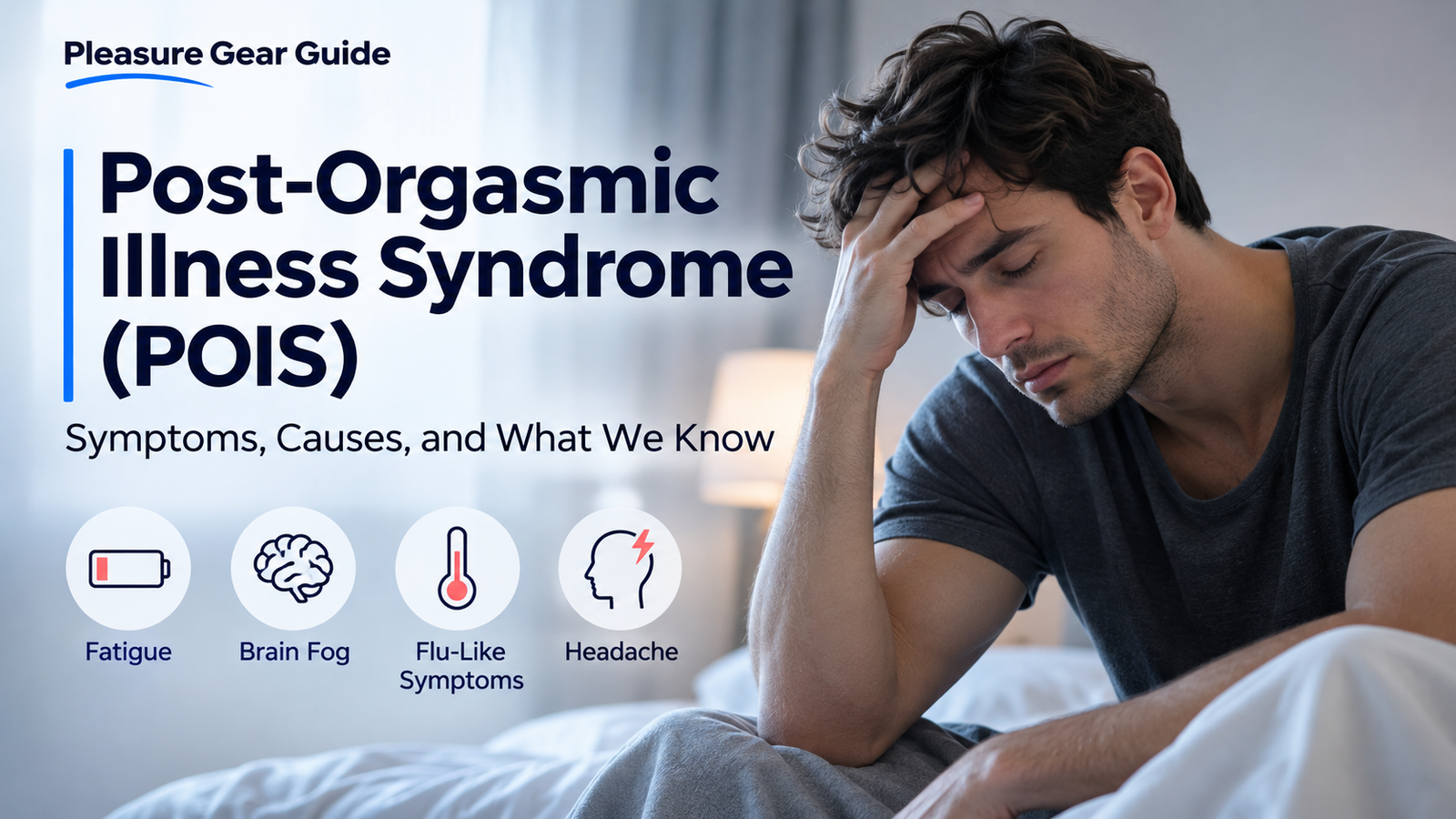
Post-Orgasmic Illness Syndrome (POIS): Symptoms, Causes, and What We Know
Medical Review and Liability Disclaimer
This article has not been medically reviewed or approved by a licensed healthcare professional.
Pleasure Gear Guide provides this content for general educational and informational purposes only. It is based on publicly available medical studies and professional health information. It does not constitute medical advice, diagnosis, or treatment.
Although reasonable efforts have been made to present accurate information, medical research continues to evolve. We cannot guarantee that the information is complete, current, or applicable to every individual.
Pleasure Gear Guide cannot assess individual medical circumstances. To the extent permitted by applicable law, we disclaim liability for decisions made solely in reliance on this article.
Never disregard professional medical advice, delay seeking medical care, or start, stop, or change prescribed treatment based on information from this website.
Editorial Disclosure: This article contains no affiliate links, sponsored healthcare recommendations, or paid product promotions.
Medical sources reviewed: November 8, 2026.
Feeling unusually ill after an orgasm can be confusing, especially when symptoms seem unrelated to sexual activity.
Some people report severe fatigue, difficulty concentrating, headaches, nasal congestion, or flu-like symptoms that begin shortly after orgasm or ejaculation.
These symptoms may persist for several days before gradually resolving.
Researchers have described a condition called post-orgasmic illness syndrome (POIS) to explain certain recurring patterns of symptoms.
However, POIS remains incompletely understood. Its underlying causes have not been established, its true prevalence is unknown, and no treatment has been proven reliably effective for everyone.
This guide explains what medical research currently tells us about POIS, which theories remain unproven, and when professional medical advice may be necessary.
Quick Answer: What Is Post-Orgasmic Illness Syndrome?
Post-orgasmic illness syndrome (POIS) describes a recurring pattern of systemic symptoms that occur during or soon after orgasm and cannot be better explained by another medical condition.
The condition has been studied primarily in men who experience symptoms following ejaculation.
Reported symptoms include severe fatigue, concentration difficulties, headaches, flu-like discomfort, nasal congestion, muscle pain, and mood changes.
Symptoms may begin within minutes or hours and can continue for several days.
In 2026, an international expert consensus published a provisional definition of POIS, reflecting the continuing uncertainty surrounding the condition.
Three important points should be understood:
First, POIS is documented in medical research.
Second, its cause and diagnostic boundaries remain uncertain.
Third, no established treatment has been demonstrated to work reliably for all patients.
Experiencing fatigue or discomfort after sex does not automatically indicate POIS.
Other medical conditions can produce similar symptoms and require appropriate evaluation.
What Do Researchers Know About POIS?
POIS was first described in a 2002 medical publication reporting two men who experienced recurring illness after ejaculation.
The reported symptoms included flu-like discomfort, fatigue, cognitive difficulties, and muscle-related complaints.
Later studies investigated additional cases.
A frequently cited 2011 study examined 45 men and proposed five preliminary diagnostic criteria.
Subsequent research has explored symptom patterns, possible biological mechanisms, and treatment experiences.
Despite these investigations, the medical literature remains limited.
Is POIS a Recognized Medical Condition?
POIS is documented in peer-reviewed medical publications.
It is also listed by the U.S. National Institutes of Health’s Genetic and Rare Diseases Information Center (GARD).
However, recognition of a reported clinical syndrome does not mean that every aspect of its diagnosis or biology has been established.
The 2026 international sexual medicine consensus explicitly describes its definition of POIS as provisional.
How Common Is POIS?
The true prevalence of POIS remains unknown.
Available research consists largely of selected clinical populations, small observational studies, and case reports.
These studies cannot reliably establish how frequently POIS occurs in the general population.
It may be underrecognized, but the extent of underdiagnosis has not been determined.
The existence of online patient communities does not provide a reliable estimate of prevalence.
What Are the Symptoms of POIS?
Researchers have historically organized POIS symptoms into seven clusters.
These categories help describe reported experiences. They are not a diagnostic test.
| Symptom Cluster | Reported Symptoms |
|---|---|
| General | Extreme fatigue, exhaustion, irritability, concentration difficulties |
| Flu-like | Feeling feverish, chills, sweating, general malaise |
| Head | Headaches, brain fog, heavy-headed sensation |
| Eyes | Redness, watering, itching, irritation, blurred vision |
| Nose | Congestion, sneezing, runny nose |
| Throat | Sore throat, dry mouth, hoarseness |
| Muscles | Weakness, stiffness, muscle pain or tension |
The severity and combination of symptoms differ between individuals.
Severe Fatigue
Fatigue is among the most frequently reported symptoms.
Some patients describe exhaustion severe enough to interfere with work, education, or normal daily activities.
In a 2023 retrospective study involving 37 men, general symptoms were reported in all participants.
However, this was a selected clinical group and should not be interpreted as evidence that every person with suspected POIS experiences the same severity of fatigue.
Brain Fog and Concentration Problems
Some patients describe difficulty concentrating, remembering information, finding words, or maintaining mental clarity.
The expression brain fog is a description of symptoms, not a confirmed biological mechanism.
These complaints are important to document, particularly when they affect everyday functioning.
Flu-Like Symptoms
Some patients report chills, sweating, muscle discomfort, or feeling unusually hot or cold.
However, feeling feverish does not necessarily mean that body temperature is elevated.
A measured fever, especially when associated with other concerning symptoms, should not automatically be attributed to POIS.
Mood Changes
Irritability, low mood, and other emotional changes have also been reported.
Their presence does not establish that POIS is caused by a psychiatric disorder.
Physical and emotional symptoms can coexist, and the relationship between them remains incompletely understood.
When Do POIS Symptoms Begin?
The relationship between orgasm or ejaculation and symptom onset is an important feature of the reported syndrome.
In classic male POIS studies, symptoms often begin immediately or within a few hours after ejaculation.
Episodes have been described following masturbation, partnered sexual activity, and spontaneous ejaculation during sleep.
However, orgasm and ejaculation are related but distinct physiological events.
The provisional international definition published in 2026 refers more broadly to systemic adverse symptoms occurring during or soon after orgasm.
How Long Do Symptoms Last?
The original preliminary diagnostic criteria described symptoms lasting approximately two to seven days before resolving spontaneously.
A 2023 study of 37 men reported an average symptom duration of approximately 4.7 days.
However, symptom duration varies, and not every reported presentation fits the original criteria.
The two-to-seven-day range should not be treated as an absolute diagnostic requirement.
Symptoms that persist, worsen, or differ from a person’s usual pattern warrant medical evaluation.
Primary and Secondary POIS
Researchers have described two patterns.
Primary POIS refers to symptoms that began with early ejaculation experiences.
Secondary POIS refers to symptoms that developed later, after a period without the condition.
These descriptions identify the timing of symptom onset.
They do not establish different biological causes.
What Causes Post-Orgasmic Illness Syndrome?
There is currently no confirmed single cause of POIS.
Several biological explanations have been investigated, but none has been established as a universal mechanism.
1. Immune Responses and Semen Sensitivity
An early hypothesis suggested that some men might experience an immune reaction involving components of their own seminal fluid.
In a 2011 study, 33 men underwent skin-prick testing with diluted samples of their own semen.
Twenty-nine participants had positive reactions.
However, this result did not establish that the skin reaction caused their POIS symptoms.
Later research questioned whether conventional semen allergy adequately explains the syndrome.
A study published in 2024 examined the clinical characteristics of 24 men with POIS.
Within that study, six patients and six healthy volunteers underwent additional immune testing.
Both groups showed positive intracutaneous reactions to their own semen, while skin-prick testing was negative and semen-specific IgE was not detected.
These findings suggest that positive skin reactions alone may not identify the underlying mechanism of POIS.
POIS should not be described as a proven allergy to one’s own semen.
2. Mast Cells and Inflammatory Responses
Researchers have also proposed that mast cells and inflammatory signaling could contribute to certain POIS symptoms.
Mast cells are immune cells involved in several inflammatory and allergic processes.
A 2026 narrative review discussed the possibility that orgasm-associated biological changes may trigger broader inflammatory responses in some individuals.
However, these proposals remain hypotheses.
The review did not demonstrate that mast-cell activation is the established cause of POIS.
More direct clinical and laboratory research is needed.
3. Hormonal and Neuroendocrine Factors
Hormonal abnormalities have been reported in some patients with POIS.
Individual case reports have also described symptom changes following medically supervised hormonal treatment.
However, these observations do not establish a general hormonal cause.
They also do not justify using testosterone or other hormone treatments without an appropriate medical indication.
4. Nervous System Mechanisms
Researchers have proposed possible involvement of autonomic and other nervous system processes associated with orgasm.
These explanations remain preliminary.
No single neurological mechanism has been confirmed to account for POIS.
Could POIS Have More Than One Cause?
This remains possible.
Some researchers have suggested that POIS may involve different biological mechanisms in different patients.
However, this hypothesis has not been established.
Future research may help determine whether POIS represents one condition or several overlapping clinical presentations.
How Is POIS Diagnosed?
POIS is generally evaluated using the patient’s medical history, symptom pattern, and assessment for alternative explanations.
There is no universally validated laboratory test that can independently confirm POIS.
The Original Five Preliminary Criteria
The criteria proposed in 2011 included:
- Characteristic physical, cognitive, or other symptoms.
- Symptoms beginning immediately or within hours after ejaculation.
- Symptoms occurring consistently or nearly consistently.
- Symptoms lasting approximately two to seven days.
- Spontaneous resolution of symptoms.
These criteria have been influential in POIS research.
However, they were preliminary criteria rather than a definitive diagnostic test.
A 2019 self-report study involving 127 men found that many respondents did not fulfill every original criterion.
Similarly, a 2023 clinical study involving 37 men reported that only 19 fulfilled all five preliminary criteria.
The 2026 International Definition
The Fifth International Consultation on Sexual Medicine introduced a broader provisional definition, published in 2026.
It describes POIS as a pattern of systemic adverse symptoms occurring during or soon after orgasm that cannot be better classified under another diagnosis.
This formulation emphasizes two considerations:
The temporal relationship with orgasm matters.
Other potential explanations must also be evaluated.
The definition remains provisional because further research is needed.
What Other Conditions Might Be Considered?
Depending on the symptoms, clinicians may consider other explanations, including genitourinary infections or inflammatory conditions, chronic pelvic pain, headache disorders associated with sexual activity, allergic conditions, and other medical causes of recurring fatigue or neurological symptoms.
Postcoital dysphoria and other emotional experiences may also need to be distinguished from systemic illness.
These conditions are not necessarily related to POIS and may require different approaches to evaluation.
What Tests Are Used?
There is no standard set of laboratory tests that establishes POIS in every patient.
A clinician may consider investigations based on the person’s symptoms, examination findings, medications, and medical history.
Tests may be used to assess alternative explanations rather than to confirm POIS directly.
Skin testing with autologous semen is not an established stand-alone diagnostic test for POIS.
Can Women Experience POIS-Like Symptoms?
Most published POIS research has focused on men.
However, illness symptoms associated with orgasm have also been reported in women.
The terminology requires care.
In the international expert consensus published in 2026, Female Orgasm Illness Syndrome (FOIS) is described separately from the male POIS definition.
FOIS refers to adverse peripheral or central symptoms occurring before, during, or after orgasm that are not simply attributable to reduced orgasm quality.
The relationship between FOIS and classic male POIS remains an area requiring further research.
It would therefore be inaccurate to assume that all orgasm-associated illness symptoms in women are identical to the syndrome historically studied in men.
People experiencing distressing, recurring symptoms associated with orgasm should seek appropriate medical evaluation regardless of sex.
What Treatments Have Been Studied for POIS?
There is currently no established treatment that has been proven reliably effective for everyone with POIS.
A systematic review published in 2025 examined the limited medical literature on POIS treatment.
The available evidence consisted primarily of small observational studies and case reports.
These designs can describe individual experiences but generally cannot establish treatment effectiveness with the confidence provided by larger controlled studies.
Antihistamines
Some case reports have described symptom improvement following antihistamine treatment.
Other patients have experienced little or no improvement.
These mixed findings do not establish antihistamines as a standard POIS treatment.
They also do not prove that POIS is primarily an allergic condition.
Anti-Inflammatory Medicines
Nonsteroidal anti-inflammatory drugs (NSAIDs) have been reported in POIS treatment studies.
Some patients experienced partial improvement.
However, the evidence remains insufficient to establish reliable effectiveness.
NSAIDs can cause adverse effects and may be unsuitable for certain individuals.
Antidepressant Medications
Selective serotonin reuptake inhibitors (SSRIs) and other psychiatric medications have been described in some treatment reports.
Individual patients have reported improvement, but these observations are not sufficient to establish SSRIs as an effective standard treatment for POIS.
Prescription medications may produce adverse effects or interact with other medicines.
They should not be started, stopped, or adjusted without professional guidance.
Hormonal Treatment
Hormonal treatment has been described in selected cases, including patients with identified hormonal abnormalities.
These experiences cannot be generalized to everyone with POIS.
Treatment decisions should depend on an appropriate clinical assessment and established indications.
Immune-Based Treatments
Desensitization involving a patient’s own seminal fluid has been investigated in a small number of cases.
Early reports described improvement in some individuals.
However, later findings have been inconsistent.
In the 2024 study of 24 patients, five underwent desensitization treatment.
Four of those five patients did not achieve the intended therapeutic benefit.
Desensitization using seminal fluid is not an established POIS treatment. It must never be attempted as a home procedure.
What Do Recent Studies Show?
A 2026 clinical case series reported 11 men with POIS.
The study described clinical presentations and treatment experiences.
However, the small number of patients, treatment differences, and limitations in follow-up prevent firm conclusions about treatment effectiveness.
A separate 2026 narrative review explored possible immune and inflammatory mechanisms.
Neither publication established a universally effective treatment.
Are There Any Proven Cures?
No scientifically established cure has been shown to work reliably across patients.
Individual reports of improvement are important for generating research questions, but they should not be interpreted as proof of effectiveness.
More rigorous clinical research is required.
Living With Recurring Symptoms After Orgasm
POIS-like symptoms can interfere with daily activities, relationships, and sexual well-being.
Because the underlying cause may be unclear, recording symptoms can help make medical consultations more informative.
A symptom record may include:
- The date and time symptoms began.
- Whether symptoms followed orgasm, ejaculation, or another event.
- The type and severity of symptoms.
- How long symptoms persisted.
- Whether there was a measured fever or another objective finding.
- Relevant medication changes or other health circumstances.
- Whether similar symptoms occurred without sexual activity.
The purpose is to identify patterns for discussion with a healthcare professional.
Do not deliberately provoke symptoms or repeatedly engage in sexual activity to test a suspected diagnosis.
Which Doctor Should You See?
A primary care clinician is a reasonable starting point.
Depending on the symptoms, referral to a urologist, sexual medicine specialist, allergist, neurologist, or another healthcare professional may be appropriate.
No single specialist pathway is suitable for every person with suspected POIS.
Questions to Ask Your Doctor
During a consultation, it may help to discuss the following:
- Could my symptoms have a medical explanation other than POIS?
- Does the timing and recurrence of my symptoms suggest a recognizable clinical pattern?
- Are any examinations or tests appropriate for ruling out other conditions?
- Would consultation with a specialist be helpful?
- How should I monitor changes in my symptoms?
- Are there warning signs that require more urgent medical attention?
These questions are intended to support communication with a clinician, not to direct a particular diagnosis or treatment.
When Should You Seek Urgent Medical Care?
Do not automatically attribute severe symptoms occurring during or after sexual activity to POIS.
A sudden, extremely severe headache associated with sexual activity requires emergency medical assessment.
Although not every sex-associated headache is dangerous, a new thunderclap headache can indicate a serious neurological condition, including bleeding around the brain.
Other concerning symptoms include difficulty breathing, loss of consciousness, new weakness, severe confusion, or other signs of a medical emergency.
If these symptoms occur, seek immediate emergency care using the appropriate local emergency service.
A suspected POIS diagnosis should never delay urgent assessment.
What Are the Biggest Gaps in POIS Research?
Despite increasing medical interest, several major questions remain unanswered.
Prevalence
Researchers do not know how frequently POIS occurs in the general population.
Biological Causes
Immune, inflammatory, hormonal, and neurological explanations have been proposed, but no single mechanism has been confirmed.
Diagnostic Standards
The traditional five preliminary criteria have limitations, and the 2026 international definition remains provisional.
Treatment Effectiveness
Most published evidence comes from small studies and individual cases.
Well-designed comparative studies are needed.
Different Symptom Patterns
Researchers still need to determine whether patients with different symptom clusters have different underlying mechanisms or treatment responses.
Female Orgasm-Associated Illness
More research is needed to characterize FOIS and clarify its relationship to POIS.
Frequently Asked Questions
Is POIS the same as feeling tired after sex?
No.
Ordinary temporary tiredness after sexual activity does not establish POIS.
The reported syndrome involves recurring, sometimes disabling symptoms that may affect multiple body systems.
Can POIS happen after masturbation?
Yes.
The classic literature includes symptoms following masturbation, partnered sexual activity, and spontaneous ejaculation during sleep.
However, symptoms after masturbation alone do not confirm POIS.
Does POIS always last two to seven days?
No.
The two-to-seven-day range comes from older preliminary criteria.
Duration varies, and the current provisional definition is not restricted to that exact period.
Is POIS caused by an allergy to semen?
This is one historical hypothesis, but it has not been established as a universal cause.
Research has produced conflicting findings.
Can women experience POIS-like symptoms?
Yes, orgasm-associated illness symptoms have been reported in women.
However, FOIS is described separately in the 2026 international consensus, and further research is needed.
Is POIS a sexually transmitted infection?
POIS is not classified as a sexually transmitted infection.
However, infections and other medical conditions can produce overlapping symptoms.
A person should not use a suspected POIS diagnosis to rule out infection.
Can POIS be diagnosed with a blood test?
There is no universally validated blood test that independently confirms POIS.
Testing may be useful for investigating other possible causes.
Is there a cure for POIS?
No reliably effective, established cure has been demonstrated.
Individual case reports describe improvement with different treatments, but these observations require further investigation.
Can supplements or antihistamines prevent POIS?
The current evidence does not establish a reliable preventive effect from supplements or antihistamines.
Self-treatment based on anecdotal reports may carry risks.
Should I avoid all sexual activity if I suspect POIS?
There is no universal recommendation that everyone with suspected POIS must avoid sexual activity.
Decisions about symptoms, sexual activity, and treatment should be discussed with an appropriate healthcare professional.
Final Thoughts: What We Know About POIS
Post-orgasmic illness syndrome is a documented but incompletely understood clinical phenomenon.
Research has identified recurring patterns of fatigue, cognitive difficulties, flu-like discomfort, and other symptoms associated with orgasm or ejaculation.
However, several fundamental questions remain unresolved.
The cause of POIS is unknown.
Its diagnostic definition remains provisional.
No universally effective treatment has been established.
It is therefore important not to present semen allergy, hormonal changes, mast-cell activation, or any other proposed mechanism as a proven explanation.
For people experiencing recurring or disabling symptoms, professional medical evaluation is more appropriate than self-diagnosis or experimental treatment.
Continued research is essential to clarify the biological mechanisms, improve diagnostic standards, and identify treatments supported by reliable evidence.
References and Further Reading
The following sources were reviewed when preparing this article.
1. Trost et al. (2026) — International Consensus Statement
Definitions, Classification, and Epidemiology of Sexual Dysfunction
Role of the document: The most important resource for explaining the latest provisional definition of POIS and distinguishing it from FOIS in women.
2. National Institutes of Health (NIH) — GARD
Postorgasmic Illness Syndrome — NIH Rare Disease Information
Purpose of the Material: An overview of POIS, its symptoms, the fact that its causes remain unknown, and official information regarding consultation with medical institutions.
3. Waldinger & Schweitzer (2002) — First Case Reports
Postorgasmic Illness Syndrome: Two Cases
Purpose of the document: This is the first study to report POIS in the medical literature. It presents two early case reports.
4. Waldinger et al. (2011) — Clinical Study of 45 Men
Postorgasmic Illness Syndrome in 45 Dutch Caucasian Males (Part 1)
Purpose of the document: A study examining early diagnostic criteria, seven symptom clusters, and hypotheses regarding immune responses.
5. Strashny (2019) — Diagnostic Criteria
First Assessment of the Validity of the Diagnostic Criteria for POIS
Purpose of the Study: A study that examined the limitations of conventional diagnostic criteria using self-reported data from 127 participants.
6. Chea et al. (2023) — Retrospective Cohort Study
Postorgasmic Illness Syndrome: One or Several Entities?
Purpose of the document: A study that investigated the symptoms, onset, duration, and treatment history of 37 men.
7. Xi et al. (2024) — Immune Response Study
Purpose of the Study: A study examining the clinical data of 24 patients, as well as immunological testing and desensitization therapy administered to some of the participants.
*You can read the full text of this paper for free.
8. Ponce et al. (2025) — Systematic Review
Treatments for Postorgasmic Illness Syndrome: A Systematic Review
Purpose of the document: To summarize the treatments that have been studied and reported in relation to POIS and to explain the limitations of the evidence.
9. Gokani et al. (2026) — Clinical Case Series
Postorgasmic Illness Syndrome: A Clinical Case Series of 11 Patients
Purpose of the document: A case study involving 11 patients published in 2026.
10. Pfaus & Yee (2026) — Possible Immune Mechanisms
Possible Role of Mast Cells, Immunoglobulins, and Multi-Organ System Inflammatory Response
Purpose of the document: A review article explaining hypotheses currently being studied as causes of POIS, such as mast cells, immune responses, and inflammation.
*This study does not prove a causal relationship.
11. International Society for Sexual Medicine (2026)
Defining Postorgasmic Illness Syndrome With a Case Series
Purpose of the document: An explanatory article from a professional academic society that clearly explains the research objectives, results, and limitations of 11 case studies conducted in 2026.
12. National Health Service (NHS)
Subarachnoid Haemorrhage — Symptoms and Emergency Warning Signs
Purpose of this document: Official medical information explaining when to seek emergency medical care for sudden, severe headaches that occur during sexual activity or similar situations.
Editorial Transparency
This article was prepared by the Pleasure Gear Guide editorial team using publicly available medical literature and professional healthcare resources.
It has not undergone independent medical peer review. The editorial team has not conducted clinical examinations, laboratory investigations, or original research on POIS.
The inclusion of a study does not constitute an endorsement of its findings or of any treatment discussed.
Observational studies, case reports, and theoretical reviews have important limitations and should not be interpreted as definitive evidence of causation, safety, or treatment effectiveness.
This article contains no affiliate links, sponsored treatment recommendations, or paid product promotions.