Silicone vs TPE Sex Toys: Safety, Cleaning, and What to Choose
Choosing your first sex toy? The material matters more than you might think.
Two toys can look almost identical in product photos but behave very differently when it comes to cleaning, durability, texture, and everyday care.
Silicone and TPE are two materials commonly found in sex toys. Both can feel soft and flexible, but they are not interchangeable.
You may also encounter the term TPR, which makes the terminology even more confusing.
This beginner-friendly guide explains what these materials mean, how they differ, and what to check before buying.
We’ll focus on practical questions: Which material is easier to clean? Is TPE safe? What lubricants can you use? And when should you replace a toy?
The goal is not to label every product as either good or bad. It is to help you make an informed choice.
Quick Answer: Is Silicone Better Than TPE?
For beginners who prioritize hygiene, easy cleaning, and long-term use, a well-made toy made from clearly identified, non-porous silicone is generally the more practical choice.
TPE products can offer a softer, more flexible feel and are often less expensive. However, many TPE sex toys are more difficult to clean thoroughly and require more careful maintenance.
The most important differences are:
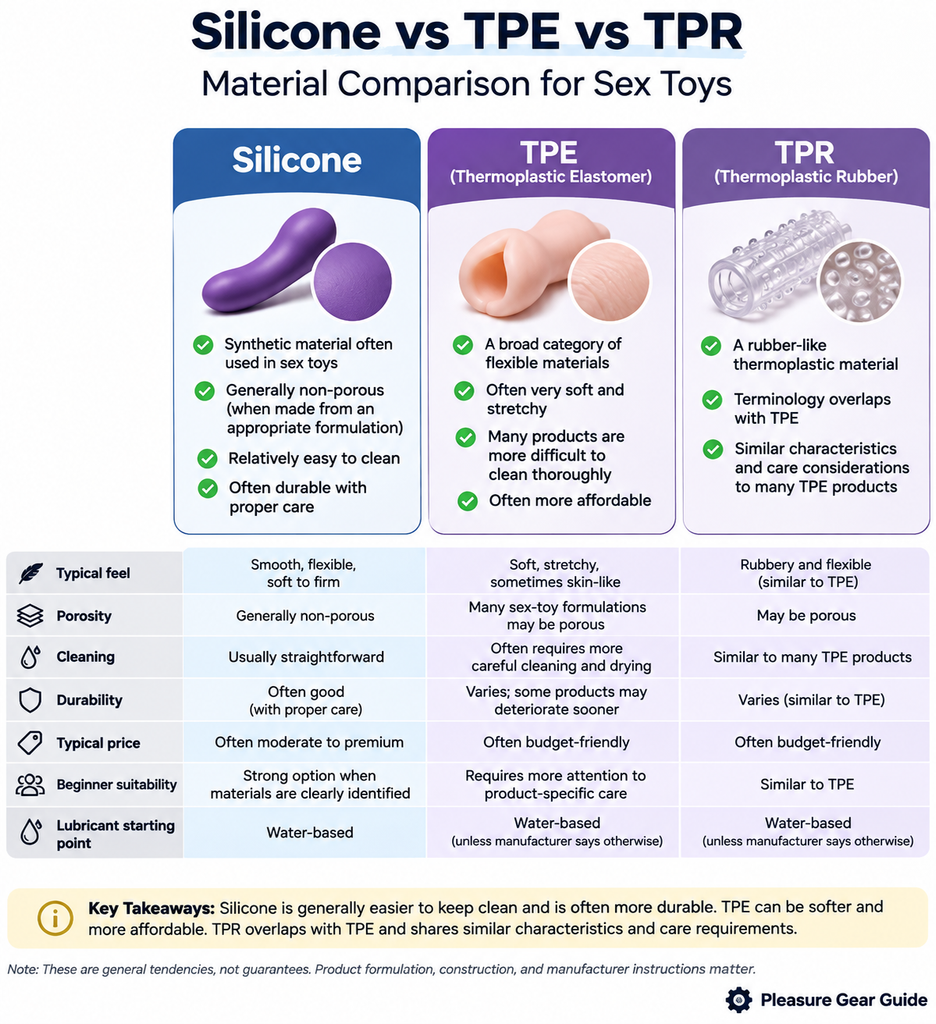
- Silicone: Generally non-porous when the product is made from an appropriate silicone formulation. Easier to clean and often more durable.
- TPE: A broad family of flexible materials. Some products are very soft and affordable, but many have greater hygiene and maintenance limitations.
- TPR: A term often used for thermoplastic rubber. It overlaps substantially with TPE rather than describing one entirely separate material.
Our beginner recommendation: Choose a reputable product that clearly identifies its materials and provides specific cleaning and lubricant instructions.
For products intended for internal use, non-porous materials are generally the preferred option.
At a Glance
| Feature | Silicone | TPE / TPR |
|---|---|---|
| Typical feel | Smooth, flexible, soft to firm | Soft, stretchy, sometimes skin-like |
| Porosity | Generally non-porous when made from appropriate silicone | Many sex-toy formulations may be porous |
| Cleaning | Usually straightforward | Often requires more careful cleaning and drying |
| Durability | Often good with proper care | Varies; some products may deteriorate sooner |
| Typical price | Often moderate to premium | Often budget-friendly |
| Beginner suitability | Strong option when materials are clearly identified | Requires more attention to product-specific care |
| Lubricant starting point | Water-based | Water-based, unless manufacturer says otherwise |
Important: These are general tendencies, not guarantees. Product formulation, construction, coatings, and manufacturer instructions matter.
What Are Silicone, TPE, and TPR?
Before comparing sex toys, it helps to understand what these names actually mean.
What Is Silicone?
Silicone is a family of synthetic materials used in many consumer, industrial, and healthcare products.
In sex toys, suitable silicone formulations can provide a flexible, smooth, non-porous surface.
Depending on how a product is made, silicone can feel:
- Soft and flexible
- Smooth and slightly velvety
- Firm but bendable
- Stretchy or cushioned
One reason silicone is popular is that it can combine flexibility with relatively easy cleaning.
However, not every product advertised as “silicone” provides the same level of material transparency.
A label such as “silicone-like” or “silicone blend” does not necessarily mean the entire surface is made from an identified, non-porous silicone formulation.
Beginner tip: Look for a specific material description from a reputable manufacturer rather than relying on appearance alone.
What Is TPE?
TPE stands for thermoplastic elastomer.
Rather than referring to one fixed substance, TPE describes a broad category of materials that combine elastic properties with thermoplastic processing characteristics.
In simple terms, some TPE formulations can feel rubbery or stretchy while being manufactured using processes associated with plastics.
Sex-toy manufacturers may use TPE for products designed to feel:
- Very soft
- Flexible
- Stretchy
- Skin-like
- Cushioned
TPE is often found in masturbator sleeves and other soft products.
However, TPE is a broad category.
Two products labeled TPE may have different formulations, textures, additives, and care requirements.
This makes it difficult to judge an individual product’s safety or durability from the letters “TPE” alone.
What Is TPR?
TPR stands for thermoplastic rubber.
In consumer products, TPR is often used as a name for rubber-like thermoplastic materials.
TPE and TPR are not always two clearly separate material families.
The terminology overlaps, and manufacturers may use it differently.
This matters because a product comparison that treats TPE and TPR as completely unrelated materials can be misleading.
For buyers, the more useful questions are:
- What is the product’s actual material formulation?
- Is the surface non-porous?
- Does the manufacturer provide detailed cleaning instructions?
- Are there restrictions on lubricants or disinfectants?
- Is the product intended for external or internal use?
These details are more important than the label alone.
Silicone vs TPE: The Differences That Matter Most
1. Texture and Flexibility
Both silicone and TPE can feel soft.
Silicone comes in different firmness levels, so it can be used for products ranging from flexible vibrators to firmer shapes.
Some TPE products are designed to stretch or compress more easily, producing a softer or more skin-like sensation.
Neither material is automatically more comfortable for everyone.
Texture preference is personal, and product design matters just as much as the material.
A well-designed silicone toy may feel more comfortable than a poorly designed TPE toy, or vice versa.
What to look for: Product dimensions, firmness, flexibility, surface texture, and whether the product is designed for the type of use you want.
2. Hygiene and Porosity
This is one of the most important differences.
A non-porous material has a surface that is generally easier to clean because it does not readily absorb substances into the material.
Appropriate silicone formulations are generally considered non-porous.
Many TPE and TPR sex toys, however, may have porous surfaces or structures that make complete cleaning and disinfection more difficult.
That does not mean every TPE product is automatically dangerous.
It means that the material label alone may not provide enough information to establish the product’s hygiene characteristics.
For toys intended for vaginal or anal insertion, sexual-health guidance generally favors known, non-porous materials.
Important distinction: Washing a product and fully disinfecting it are not the same thing.
Cleaning can remove surface residue, but it does not guarantee that every microorganism has been eliminated.
A product that cannot be reliably disinfected may be less suitable for sharing or for situations requiring stricter hygiene.
3. Durability
Well-made silicone products can offer good long-term durability when used and stored correctly.
TPE products vary considerably.
Some can remain usable with proper maintenance, while others may become sticky, discolored, or damaged over time.
The actual lifespan depends on factors such as:
- Material formulation
- Frequency of use
- Cleaning products
- Lubricant compatibility
- Storage conditions
- Exposure to heat or sunlight
There is no reliable universal lifespan that applies to every silicone or TPE sex toy.
4. Price
TPE products are frequently found at lower price points.
Silicone products often cost more, although affordable silicone options also exist.
Price alone is not a dependable indicator of material safety.
An expensive product can have inadequate material information, while a reasonably priced product may provide clear specifications and care instructions.
A better buying question is: “Can I verify what this product is made from and how to maintain it?”
Are TPE Sex Toys Safe?
The answer depends on the specific product and how it is intended to be used.
TPE is not one standardized sex-toy formulation, so it would be inaccurate to declare every TPE product either safe or unsafe.
The main concerns involve material transparency, hygiene, and product-specific quality.
Porosity and Cleaning Limitations
Some TPE products may be difficult to disinfect thoroughly because of their material structure.
This can become particularly relevant when a toy:
- Is intended for internal use
- Has a textured interior
- Contains narrow channels that are difficult to dry
- Is shared between users
- Develops surface damage
A manufacturer may recommend cleaning with mild soap and water, but cleaning instructions should not be interpreted as proof that a porous material can be sterilized.
What Does “Phthalate-Free” Mean?
Some manufacturers advertise products as “phthalate-free.”
Phthalates are a group of chemicals used in certain materials, including some flexible plastics.
A phthalate-free claim may provide information about one aspect of a product’s composition.
However, “phthalate-free” does not automatically mean non-porous, completely safe, or easy to disinfect.
Similarly, labels such as “skin-safe,” “premium material,” and “body-friendly” should not replace clear material specifications.
What About Product Safety Standards?
ISO 3533:2021 is an international standard addressing design, material safety, and user information requirements for certain manufactured sex toys.
The existence of this standard is useful for understanding what manufacturers should consider.
However, an individual product should not be assumed to comply with ISO 3533 simply because the standard exists.
If a manufacturer makes a compliance claim, look for clear supporting information.
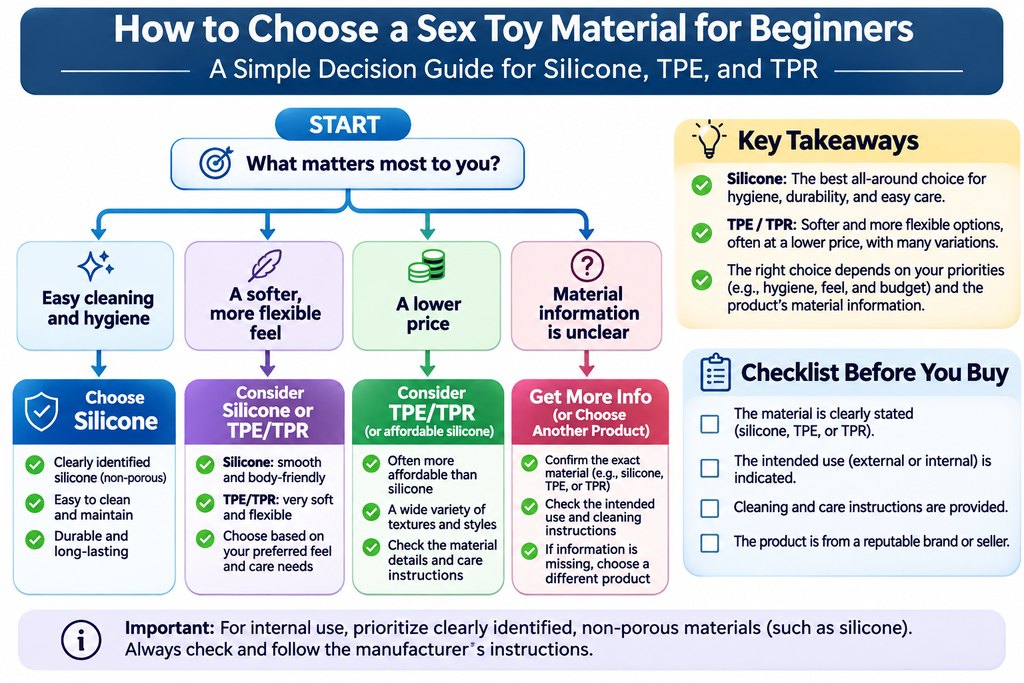
Which Sex Toy Material Should a Beginner Choose?
There is no single perfect material for everyone.
However, some decisions are easier when you start with your main priority.
If Easy Cleaning Matters Most
Choose a product made from clearly identified, non-porous material.
Silicone is a common choice, but suitable hard plastics, stainless steel, and purpose-made glass products are also options.
Remember that a non-porous surface still needs cleaning.
If You Want a Very Soft Texture
You may prefer a softer silicone design or a product made from another flexible material.
Do not assume you need TPE to get a soft texture.
Silicone products are available in different firmness levels.
If Your Budget Is Limited
Focus on transparent product information rather than price alone.
A smaller or simpler silicone toy may be a more practical purchase than a larger product with unclear materials and care requirements.
If You Are Considering a TPE Product
Before purchasing, check:
- The manufacturer’s material description
- Whether the product is intended for internal use
- Its cleaning and drying instructions
- Compatible lubricants
- Storage requirements
- Any replacement or deterioration warnings
If essential information is missing, consider another product or contact the manufacturer.
How to Clean Silicone and TPE Sex Toys
Cleaning is essential regardless of the material.
Follow the manufacturer’s instructions first, because waterproofing, electronic components, coatings, and construction can change what cleaning methods are appropriate.
Cleaning Silicone Toys
For many silicone toys, the basic routine is straightforward:
Step 1: Check the manufacturer’s instructions.
Confirm whether the product is waterproof, water-resistant, or unsuitable for immersion.
Step 2: Clean with mild soap and warm water.
Use a gentle cleaning method appropriate for the product.
Pay attention to seams, textured areas, and places where different components meet.
Step 3: Rinse and dry thoroughly.
Remove cleaning residue and allow the product to dry completely.
Step 4: Store in a clean, dry place.
A separate storage pouch can help protect the surface from dust and contact with other materials.
Some solid, non-electronic silicone products may tolerate additional sanitation methods.
However, never boil or submerge a product unless its manufacturer explicitly confirms that the method is suitable.
Cleaning TPE Toys
Many TPE products require more careful handling.
A typical routine may include:
Step 1: Follow the exact product instructions.
Do not assume every TPE product tolerates the same soap, temperature, or cleaning solution.
Step 2: Clean the accessible surfaces gently.
Where permitted, use warm water and a mild cleaner suitable for the material.
Avoid harsh chemicals unless specifically approved by the manufacturer.
Step 3: Pay particular attention to internal channels.
Soft sleeves and textured interiors can be difficult to rinse and dry completely.
A product with a removable sleeve may be easier to maintain, depending on its design.
Step 4: Dry completely before storage.
Trapped moisture can create hygiene problems.
Do not put a damp sleeve into a sealed storage container.
Step 5: Inspect the material.
Check for tears, tackiness, discoloration, unusual odors, or other signs of deterioration.
Can You Boil TPE Toys?
Do not boil a TPE toy unless its manufacturer explicitly authorizes that method.
Heat may damage some formulations or deform the product.
More importantly, boiling should not be assumed to solve the cleaning limitations associated with a porous material.
Can You Share Silicone or TPE Toys?
Sharing toys introduces additional hygiene considerations.
Use appropriate barriers, such as a new condom, when applicable. Change the barrier between people and between different body areas.
Clean the toy according to its instructions.
For sharing, a known non-porous material that can be cleaned appropriately is generally preferable.
A condom may reduce certain risks, but it does not make an inadequately cleaned or damaged toy automatically safe.
Which Lubricants Work With Silicone and TPE?
Lubricant compatibility is another important part of material selection.
Using an incompatible lubricant may alter a toy’s surface or damage the material.
Water-Based Lubricants
Water-based lubricant is usually the simplest starting point for beginners.
It is generally compatible with many common sex-toy materials, including silicone and many TPE products.
However, always check the instructions for the specific toy and lubricant.
Silicone-Based Lubricants
Silicone-based lubricants can be long-lasting, but compatibility requires more care.
Some silicone-based lubricants may affect certain silicone toy surfaces.
They may also be unsuitable for some soft thermoplastic products.
If compatibility is not clearly confirmed, choose a water-based alternative.
Oil-Based Lubricants
Oil-based products are not universally compatible with sex-toy materials.
They can also damage latex condoms.
Avoid assuming that a lubricant suitable for skin or massage is suitable for a toy or barrier method.
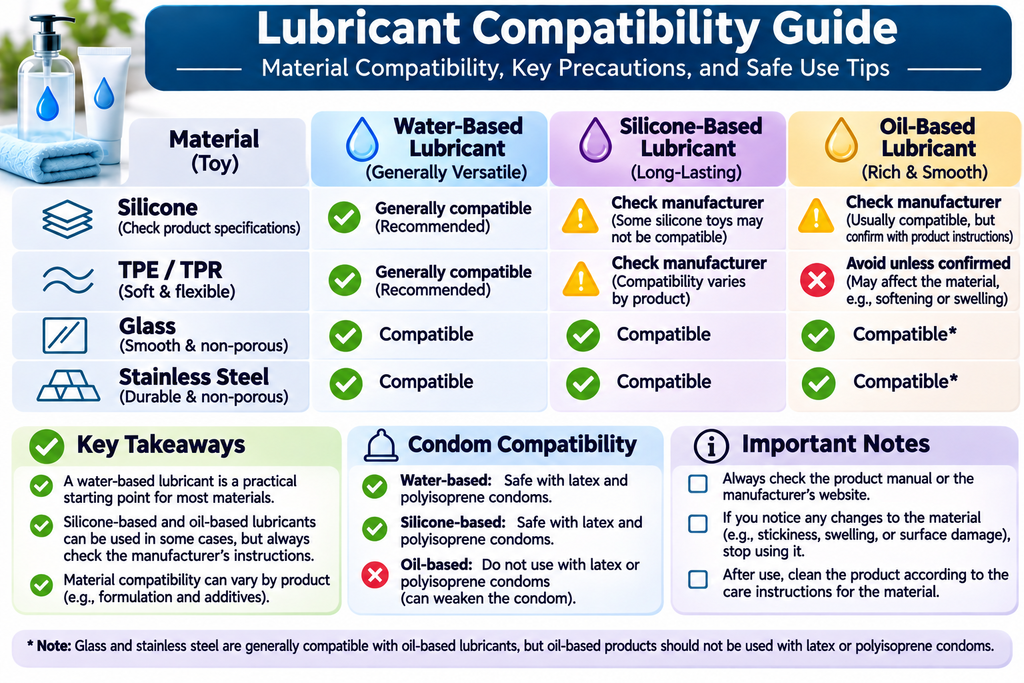
Quick Lubricant Compatibility Guide
| Toy material | Water-based lube | Silicone-based lube | Oil-based lube |
|---|---|---|---|
| Silicone | Generally preferred | Check manufacturer; avoid if uncertain | Check product and condom compatibility |
| TPE / TPR | Common starting point | Do not assume compatibility | Do not assume compatibility |
| Glass | Generally compatible | Generally compatible | Check barrier compatibility |
| Stainless steel | Generally compatible | Generally compatible | Check barrier compatibility |
The safest practical rule is to follow the specific manufacturer’s compatibility instructions rather than relying only on a material category.
For a more detailed explanation, read our guide:
Water-Based vs Silicone-Based Lube for Sex Toys: Which Is Safe?
How to Check a Sex Toy’s Material Before Buying
Product listings are not always equally informative.
Use this checklist before purchasing.
1. Look for a Specific Material Name
A clear description such as “silicone” or “TPE” provides more information than vague wording such as “soft-touch material.”
However, even a named material does not tell you everything about its formulation.
2. Check the Manufacturer, Not Just the Retailer
Retail listings may simplify or shorten material descriptions.
Look for the manufacturer’s official product page or instructions.
3. Read the Cleaning Instructions
If the manufacturer does not explain how to clean and dry the product, consider that a warning sign.
Cleaning requirements are an important part of ownership.
4. Confirm Lubricant Compatibility
Do not assume a lubricant is compatible based only on the toy’s appearance.
Check the material information and any specific restrictions.
5. Consider the Intended Use
A product designed for external stimulation may have different hygiene requirements from one intended for vaginal or anal insertion.
For internal use, choosing a well-identified, non-porous material is generally a sensible precaution.
For anal use, the product must also have a suitable flared base or other design feature that prevents it from being drawn entirely inside.
6. Look for Realistic Safety Information
Be cautious about sweeping claims such as:
- “100% safe for everyone”
- “Never needs replacing”
- “Completely bacteria-proof”
- “Compatible with every lubricant”
Responsible manufacturers should explain limitations as well as benefits.
When Should You Replace a Sex Toy?
There is no universal replacement schedule that applies to every product.
Instead, inspect toys regularly.
Consider replacing a product if you notice:
- Tears or cracks
- A sticky or deteriorating surface
- Persistent unpleasant odors
- Unusual discoloration
- Surface changes that do not resolve with appropriate cleaning
- Damaged seams or components
- Problems with waterproof seals
For glass products, chips or cracks are particularly important warning signs.
For powered products, damaged charging ports or other electrical problems also require attention.
Do not continue using a damaged toy simply because it was expensive or has not been owned for very long.
Material safety depends partly on the product remaining in good condition.
Frequently Asked Questions
Is Silicone Always the Safest Sex Toy Material?
No material guarantees safety in every situation.
Well-made, non-porous silicone is commonly recommended because it is relatively easy to clean and can be durable.
However, design quality, manufacturing, intended use, and appropriate maintenance also matter.
Is TPE the Same as TPR?
Not exactly, but the terms overlap.
TPE is a broad material category, while TPR is often used to describe rubber-like thermoplastic materials.
Manufacturers may use these terms inconsistently.
Do not assume that a TPR product is automatically safer, softer, or more durable than one labeled TPE.
Are All TPE Sex Toys Porous?
You should not assume identical surface properties across every TPE formulation.
However, many TPE sex toys are treated as potentially porous in sexual-health guidance.
Unless the manufacturer provides reliable information establishing otherwise, take a cautious approach to hygiene, especially for internal use or sharing.
Does a Higher Price Mean a Safer Material?
Not necessarily.
Price may reflect branding, design, electronics, or other features.
Clear material information and appropriate care instructions are more useful indicators than price alone.
Can I Use Silicone Lubricant With a Silicone Toy?
Some combinations may affect a toy’s surface.
Unless the manufacturer explicitly confirms compatibility, water-based lubricant is generally the simpler option.
Is a Toy Labeled “Medical-Grade Silicone” Automatically Safe?
No.
A material claim does not guarantee that the entire finished product is safe for every use.
You should still examine product design, surface condition, cleaning requirements, and the credibility of the manufacturer’s information.
Can I Share a TPE Toy if I Wash It?
Washing alone may not reliably address the hygiene limitations of a potentially porous material.
Appropriate barriers can reduce some risks, but using separate toys or choosing products designed for hygienic sharing may be preferable.
Follow relevant sexual-health guidance and the manufacturer’s instructions.
Can I Clean Every Silicone Toy in Boiling Water?
No.
Some solid silicone products without electronics may tolerate boiling, but others may contain components, coatings, or construction features that cannot withstand it.
Only use boiling if the manufacturer specifically permits it.
Final Verdict: Silicone or TPE?
For most beginners, a clearly identified, non-porous silicone toy from a reputable manufacturer is a practical starting point.
It offers a useful combination of flexibility, relatively straightforward cleaning, and potentially good durability.
TPE products may appeal to people seeking a particular soft or stretchy feel, or a lower purchase price.
However, they generally deserve closer scrutiny of their cleaning requirements, material specifications, and expected maintenance.
Neither price nor material name alone can guarantee a good purchase.
Before choosing any toy, ask yourself:
- Do I know what it is made from?
- Is it appropriate for its intended use?
- Can I clean and dry it properly?
- Does the manufacturer explain lubricant compatibility?
- Will I be comfortable following its care instructions?
If the answers are clear, you are in a much better position to make an informed choice.
The best beginner sex toy is not necessarily the softest, most expensive, or most realistic-looking one. It is a product whose materials, design, and maintenance requirements you understand.
Sources and Further Reading
The following resources provide general sexual-health guidance, information about material selection, or product safety standards.
1. Planned Parenthood — Sex Toys
Guidance on choosing materials, cleaning toys, lubricant compatibility, and safer use.
2. International Organization for Standardization — ISO 3533:2021
Sex toys — Design and safety requirements for products in direct contact with genitalia, the anus, or both.
https://www.iso.org/standard/79631.html
3. University of British Columbia — Sexual Health Shop Cleaning Guide
Practical cleaning and care instructions for a range of sex-toy products.
https://students.ubc.ca/wp-content/uploads/sexual_health_shop_cleaning_guide.pdf
4. LGBT Foundation — Sex Guides
Sexual-health information that includes cleaning, storage, and lubricant precautions.
https://lgbt.foundation/wp-content/uploads/2023/08/Sex-Guide_Vaginal_NOBLEED.pdf
Editorial Note
This article is intended for general educational purposes and is not medical advice.
Material characteristics and product safety can vary by manufacturer, formulation, and intended use. Always follow the product’s official instructions.
Pleasure Gear Guide has not independently laboratory-tested the materials discussed in this article. The recommendations are based on published guidance and general material characteristics, not hands-on testing of individual products.
If you experience pain, irritation, or a suspected reaction after using a product, stop using it and seek advice from an appropriate healthcare professional.