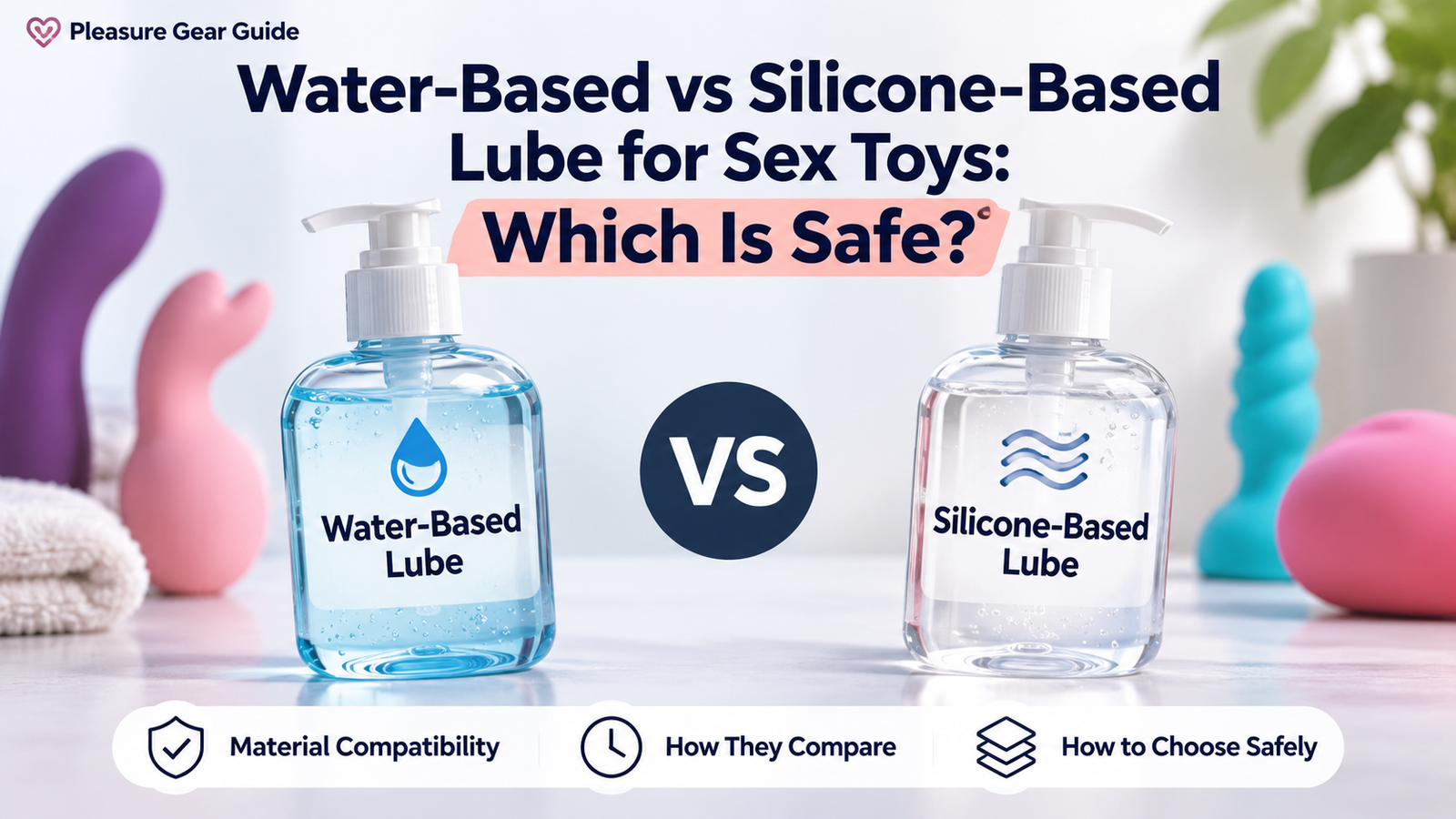
Water-Based vs Silicone-Based Lube for Sex Toys: Which Is Safe?
Choosing the right lubricant can make using a sex toy more comfortable. But not every lubricant works well with every toy material.
One of the most common questions is surprisingly simple: Can you use silicone-based lube with a silicone sex toy?
The answer depends on the materials involved. While water-based lubricants are generally compatible with most sex toys, silicone-based products may affect the surface of certain silicone and soft-touch materials.
Understanding these differences can help you protect your toys, avoid unnecessary irritation, and choose a lubricant that suits your needs.
Editorial Note: This guide provides general educational information based on publicly available sexual health guidance and manufacturer recommendations. It has not been medically reviewed by a healthcare professional. It is not a substitute for individualized medical advice. Always follow the instructions provided by your toy and lubricant manufacturers.
Quick Answer: Which Lube Is Best for Sex Toys?
Water-based lubricant is usually the safest starting point for sex toys because it is compatible with a wide range of materials, including silicone.
Silicone-based lubricant typically lasts longer and offers a more persistent slippery texture, but it should not be used with silicone toys unless the toy manufacturer confirms compatibility.
Here is the simplest way to decide:
- Using a silicone toy? Start with water-based lubricant.
- Using a TPE or TPR toy? Follow the manufacturer’s instructions; water-based lubricant is usually the safer choice.
- Using a glass or stainless-steel toy? Both water-based and silicone-based lubricants are generally compatible with the main material.
- Using latex condoms? Choose a condom-compatible water-based or silicone-based lubricant, and avoid oil-based products.
- Unsure what your toy is made from? Check its packaging or official product page before choosing a lubricant.
Remember that material compatibility and suitability for your body are separate considerations. A lubricant that does not damage a toy can still cause irritation for some people.
Not sure whether your toy is made from silicone, TPE, or TPR? Read our Silicone vs TPE Sex Toys: Safety, Cleaning, and What to Choose guide to understand material differences, cleaning requirements, and lubricant compatibility before choosing a product.
Water-Based vs Silicone-Based Lube: Comparison Table
| Feature | Water-Based Lube | Silicone-Based Lube |
|---|---|---|
| Main ingredients | Water and other formulation ingredients | Silicone compounds |
| Texture | Usually lighter and less persistent | Usually silkier and longer-lasting |
| Compatibility with silicone toys | Generally compatible | Not recommended unless manufacturer-approved |
| Compatibility with glass and steel | Generally compatible | Generally compatible |
| Compatibility with TPE/TPR | Usually preferred; verify instructions | Depends on the product |
| Latex condom compatibility | Generally compatible if labeled for use with condoms | Generally compatible if labeled for use with condoms |
| Cleanup | Usually easy with water | May require more thorough washing |
| Reapplication | Often needed more frequently | Usually needed less frequently |
| Use around water | Washes away more easily | More resistant to water |
| Best starting choice for beginners | Usually yes | Depends on the toy and intended use |
Important: This table provides general guidance, not a guarantee for every product. Toy coatings, blended materials, and specific lubricant formulations can change compatibility.
What Is Water-Based Lubricant?
Water-based lubricants use water as a primary ingredient, together with substances that create the desired texture and slipperiness.
They are widely used for sexual activity, including masturbation, partnered intimacy, and sex toy use.
Advantages of Water-Based Lube
1. Broad compatibility with sex toys
Water-based lubricant is generally suitable for silicone, glass, stainless steel, ABS plastic, and many soft elastomer toys.
This makes it a practical option for people who own several toys made from different materials.
2. Easy cleanup
Most water-based lubricants rinse away with water and are relatively easy to remove from toys, hands, and skin.
3. Condom compatibility
Products labeled as compatible with condoms are generally suitable for use with latex condoms.
4. Different textures are available
Water-based lubricants range from thin liquids to thicker gels.
A thicker formulation may be useful when additional cushioning and friction reduction are desired.
Disadvantages of Water-Based Lube
Water-based products can dry out or become tacky during use.
Depending on the formula, you may need to add more lubricant.
Some contain ingredients that may irritate sensitive skin or mucosal tissues.
A water-based label alone does not guarantee that a product will suit everyone.
Who Should Consider Water-Based Lube?
Water-based lubricant is a sensible starting choice for:
- First-time sex toy users
- People using silicone toys
- People using TPE or TPR products
- Those who prefer easy cleanup
- Anyone who frequently switches between different toy materials
For most beginners, choosing a straightforward, fragrance-free water-based lubricant is a practical first step.
What Is Silicone-Based Lubricant?
Silicone-based lubricants contain silicone compounds that create a slippery, water-resistant layer.
Unlike water-based formulas, they generally remain slippery for longer without frequent reapplication.
This can make them useful when prolonged lubrication is desirable.
Advantages of Silicone-Based Lube
1. Longer-lasting lubrication
Silicone-based lubricants usually maintain their slippery texture longer than water-based products.
2. Water resistance
They do not wash away as easily when exposed to water.
3. Reduced need for reapplication
Because they persist longer, users may need to reapply them less frequently.
4. Compatibility with some non-silicone materials
Glass, stainless steel, and certain hard plastics are generally compatible with silicone-based lubricants.
However, coatings, seals, and other components should still be checked.
Disadvantages of Silicone-Based Lube
The main concern is compatibility with certain toy materials.
Silicone-based lubricant may affect the surface of some silicone toys, potentially causing changes in texture or material degradation.
This does not mean every silicone lubricant damages every silicone toy.
Some manufacturers allow particular combinations, but compatibility should be established through official product guidance rather than assumptions.
Silicone-based products may also be more difficult to wash away and can leave residue on fabrics.
Who Should Consider Silicone-Based Lube?
Silicone-based lubricants may be suitable for people who:
- Prefer longer-lasting lubrication
- Use compatible glass or stainless-steel toys
- Want a lubricant that resists washing away
- Have confirmed that their toy and lubricant can be used together
For silicone toys, water-based lubricant remains the more straightforward choice unless the manufacturer explicitly approves silicone-based products.
Can You Use Silicone Lube With Silicone Sex Toys?
The safest general recommendation is to avoid combining silicone-based lubricant with silicone toys unless the manufacturer confirms that the combination is compatible.
Silicone toys vary in formulation, manufacturing processes, coatings, and surface treatments.
Similarly, silicone lubricants are not all identical.
Some combinations may cause changes to the toy’s surface, while others may be compatible.
Because consumers cannot reliably determine compatibility from appearance alone, manufacturer’s instructions should take priority.
What Could Happen?
Depending on the materials involved, an incompatible combination may produce:
- A sticky or tacky surface
- Changes in texture
- Surface deterioration
- Visible damage or unusual residue
If you notice these changes, stop using the toy and contact the manufacturer for advice.
Do not assume that washing will restore damaged material.
Is a Patch Test Enough?
Some manufacturers suggest checking a small, inconspicuous area before using a silicone lubricant.
However, a successful spot test does not establish long-term compatibility or prove that the combination is safe for intimate use.
Manufacturer-confirmed compatibility is preferable to relying on a home test.
When in doubt, use water-based lubricant.
Sex Toy Material Compatibility Guide
The material of your toy is one of the most important factors when choosing a lubricant.
1. Silicone Toys
Silicone is widely used in premium sex toys because of its flexibility and ease of cleaning.
For toys made from genuine, nonporous silicone, water-based lubricant is generally a good choice.
Silicone-based lubricant should only be considered when compatibility is confirmed by the toy manufacturer.
Also note that products labeled “silicone blend” may behave differently from products made with a single silicone formulation.
2. TPE and TPR Toys
Thermoplastic elastomers (TPE) and thermoplastic rubbers (TPR) are used in many soft, flexible products.
These materials may require more careful cleaning and maintenance than nonporous materials.
Some products can absorb substances or retain moisture, making proper cleaning and drying especially important.
Water-based lubricant is commonly recommended for these toys.
Do not assume that silicone-based or oil-based lubricants are suitable without checking the manufacturer’s instructions.
3. ABS Plastic Toys
ABS is a rigid plastic used in many external toy components.
The plastic itself is generally compatible with water-based and silicone-based lubricants.
However, a device may also contain silicone contact surfaces, coatings, seals, or other materials.
Check the instructions for the complete product rather than judging compatibility from its outer shell alone.
4. Glass Toys
High-quality, nonporous, body-safe glass toys are generally compatible with both water-based and silicone-based lubricants.
Check that the toy is intended for intimate use and has no cracks, chips, or damaged surfaces.
Do not use a damaged glass toy.
5. Stainless-Steel Toys
Nonporous, body-safe stainless steel is generally compatible with both types of lubricant.
As with glass toys, inspect the surface for damage and follow the manufacturer’s cleaning instructions.
Quick Compatibility Chart
| Toy Material | Water-Based Lube | Silicone-Based Lube |
|---|---|---|
| Silicone | Generally suitable | Manufacturer approval required |
| Silicone blends | Check instructions | Check instructions carefully |
| TPE | Usually preferred | Check manufacturer guidance |
| TPR | Usually preferred | Check manufacturer guidance |
| ABS plastic | Generally suitable | Generally suitable for the plastic itself |
| Body-safe glass | Generally suitable | Generally suitable |
| Body-safe stainless steel | Generally suitable | Generally suitable |
| Mixed-material devices | Check all contact materials | Check all contact materials |
Compatibility is product-specific. If the manufacturer’s instructions differ from this general chart, follow those instructions.
Which Lube Should You Use With TENGA Products?
TENGA products illustrate why it is important to look beyond broad material categories.
Different TENGA models have different structures, materials, and care requirements.
TENGA CUP
Many TENGA CUP products are designed for single use and include lubricant.
They are not intended to be washed and reused.
Before adding lubricant, check the instructions for the specific CUP model.
For an introduction to the product range, see our TENGA for Beginners guide.
TENGA EGG
TENGA EGG products use soft, stretchable material, with lubricant supplied for use according to the product instructions.
If additional lubricant is needed, consult the manufacturer’s guidance rather than assuming that every lubricant type is appropriate.
Our TENGA CUP vs EGG comparison explains some of the practical differences between these product types.
TENGA SPINNER and FLEX
Reusable TENGA products require particular attention to lubricant compatibility, cleaning, and drying.
TENGA recommends using appropriate lubricant and following the care instructions for the individual model.
Water-based lubricant is the sensible default unless the product instructions specify otherwise.
For more information about these products, read our TENGA SPINNER vs FLEX guide.
Key takeaway: Do not assume that all products from the same brand have identical lubricant requirements.
Does Lube Compatibility Affect Toy Safety?
Yes, but compatibility is only one part of safe sex toy use.
A lubricant that is compatible with a toy may still be unsuitable for a particular person.
Several additional considerations matter.
Skin and Genital Sensitivity
Some people experience irritation from fragrance, flavoring, warming ingredients, preservatives, or other components.
If you are prone to irritation, consider products with clearly disclosed ingredients and without unnecessary fragrances.
Stop using a product if you experience burning, itching, swelling, or persistent discomfort.
Seek medical advice if symptoms continue or are significant.
pH and Osmolality
The pH and osmolality of some water-based lubricants can affect how suitable they are for particular mucosal tissues.
Products intended for vaginal or rectal use may have different formulation considerations.
These factors are more complex than simply labeling a lubricant “natural” or “body-safe.”
Water-based formulas vary considerably, so readers should not assume that all products have identical effects.
When choosing a lubricant for sensitive tissues, reputable sexual health guidance and transparent manufacturer information are useful starting points.
Condoms and Other Barriers
Water-based and silicone-based lubricants are generally compatible with latex condoms when the product is specifically labeled for that use.
Oil-based products should not be used with latex condoms, because they can weaken latex and increase the risk of breakage.
Other barrier materials have different compatibility requirements.
Always check both the condom and lubricant packaging.
Using a toy-compatible lubricant does not automatically mean it is compatible with every barrier method.
Do You Need Lube With Every Sex Toy?
Not necessarily.
The need for lubricant depends on the toy, body area, type of activity, and individual comfort.
External Vibrators
Some external toys can be used comfortably without additional lubricant.
However, a small amount of compatible lubricant may help reduce friction.
Internal Vaginal Toys
Lubricant may improve comfort, particularly when natural lubrication is insufficient.
Avoid forcing penetration or continuing if it causes pain.
Anal Toys
Adequate lubricant is particularly important because the anus does not provide the same natural lubrication as the vagina.
Choose a lubricant designed for the intended use and compatible with the toy.
Any toy intended for anal insertion should also have an appropriate flared base or another reliable retrieval feature.
Male Masturbation Toys
Lubricant requirements vary considerably between products.
Some disposable devices are pre-lubricated, while reusable sleeves may require lubricant to function as intended.
Follow the instructions supplied with the device.
How to Choose the Right Lube: A Simple Checklist
Before purchasing a lubricant, ask yourself five questions.
1. What is my toy made from?
Check the official product description or packaging.
2. Does the manufacturer recommend a specific lubricant type?
Do not assume compatibility based only on whether a product feels soft or firm.
3. Will I be using a condom or another barrier?
Confirm compatibility with the specific barrier material.
4. Do I have sensitive skin or a history of irritation?
Review the ingredient list and consider avoiding unnecessary fragrances or other ingredients that have previously caused discomfort.
5. Do I prefer easy cleanup or longer-lasting lubrication?
Water-based formulas usually clean up more easily.
Silicone-based formulas usually last longer but require more attention to toy compatibility.
For people who are uncertain, a straightforward water-based product from a reputable manufacturer is often the simplest starting point.
How to Clean Sex Toys After Using Lube
Appropriate cleaning helps remove lubricant residue and reduce the chance of transferring microorganisms between uses.
The exact cleaning method depends on the toy.
As general guidance:
- Check the manufacturer’s cleaning and waterproofing instructions.
- Clean the toy after use using the recommended method.
- For toys suitable for washing, mild soap and water may be appropriate.
- Rinse thoroughly where permitted.
- Allow the toy to dry completely before storing it.
- Inspect the surface for cracks, stickiness, tears, or other damage.
Do not immerse electronic toys unless they are specifically designed for immersion.
For porous or soft elastomer materials, follow the manufacturer’s particular cleaning and replacement guidance.
When sharing toys, use appropriate barriers and clean the device between users. Replace the barrier before moving between partners or body areas.
Never move a toy directly from anal use to vaginal use without appropriate cleaning or replacing the barrier.
Common Mistakes to Avoid
Mistake 1: Assuming All Silicone Toys Are Identical
Different silicone formulations and surface treatments can behave differently.
Always check the specific product.
Mistake 2: Assuming Water-Based Means Irritation-Free
Water-based lubricants can contain ingredients that irritate some users.
Ingredient suitability and toy compatibility are separate issues.
Mistake 3: Using Oil-Based Products With Latex Condoms
Oil-based lubricants can weaken latex.
Use an appropriately labeled water-based or silicone-based lubricant instead.
Mistake 4: Ignoring the Manufacturer’s Instructions
General online advice cannot account for every toy material, coating, or lubricant formula.
Mistake 5: Reusing Disposable Products
Some masturbation products are specifically designed for a single use.
Do not wash and reuse them unless the manufacturer explicitly states that they are reusable.
Frequently Asked Questions
Can silicone-based lube damage a silicone vibrator?
It can affect the surface of some silicone toys. The risk depends on the specific materials and formulations. Unless the vibrator manufacturer confirms compatibility, water-based lubricant is the safer default.
Is water-based lube safe for all sex toys?
It is generally compatible with a very wide range of sex toy materials. However, always check the product instructions, particularly for specialty materials, coatings, and devices with unusual care requirements.
Can I use silicone lube with a glass dildo?
Silicone-based lubricant is generally compatible with the glass itself. Make sure the toy is made from body-safe, nonporous glass, is undamaged, and is intended for intimate use.
Can I use silicone lube with a stainless-steel toy?
Generally, yes. Body-safe stainless steel is usually compatible with silicone-based lubricants. Check for coatings or additional components that may have different requirements.
Is silicone-based lube better for anal toys?
Silicone-based lubricants often provide longer-lasting lubrication. However, compatibility with the toy is essential. A thicker water-based lubricant can also be a practical option.
For anal insertion, adequate lubrication and a toy with a proper flared base are important safety considerations.
Is water-based lube better for sensitive skin?
Not necessarily. Individual ingredients and formulations matter more than the lubricant category alone.
A fragrance-free water-based product may be a reasonable starting point, but no lubricant can be guaranteed to suit everyone.
Can I use coconut oil instead of personal lubricant?
Do not use coconut oil with latex condoms. Oil can weaken latex and increase the risk of failure.
Oil may also be unsuitable for certain toy materials, and its suitability for intimate tissues cannot be assumed.
A product specifically formulated and labeled for intimate use is generally the more predictable choice.
What if I already used silicone lube on a silicone toy?
Stop using that combination until compatibility is confirmed.
Clean the toy according to its instructions and inspect it for changes in texture or surface damage.
If the surface has become sticky, cracked, or otherwise deteriorated, contact the manufacturer and avoid using the damaged toy.
Do hybrid lubricants work with silicone toys?
Hybrid lubricants contain combinations of ingredients, often including both water and silicone components.
They should not automatically be treated as equivalent to water-based lubricants.
Check the manufacturer’s compatibility information for the exact formula and toy.
Final Thoughts: Which Lubricant Should You Choose?
Both water-based and silicone-based lubricants have useful properties.
The right choice depends on your toy’s material, your intended use, and your personal comfort.
For most people using sex toys, water-based lubricant is the simplest and most versatile starting point.
It works with many common toy materials, is usually easy to clean, and avoids the compatibility concerns associated with some silicone-based lubricant and silicone toy combinations.
Silicone-based lubricant may be preferable when longer-lasting lubrication is important, provided that it is compatible with the toy and any barriers being used.
The most important principle is simple:
Check the toy, check the lubricant, and follow the manufacturer’s instructions for both.
If you are comparing products before buying, our Womanizer vs Satisfyer guide can also help you understand how features and materials influence the choice of a personal wellness device.
References and Further Reading
The following sources provide additional guidance on lubricant use, toy materials, sexual health, and product care.
Planned Parenthood — Sex Toys
https://www.plannedparenthood.org/learn/sex-pleasure-and-sexual-dysfunction/sex-and-pleasure/sex-toys
Explains safer sex toy use, cleaning, lubricant compatibility, and material considerations.
Sexual Health Oxfordshire (NHS) — Lubricants and Vaginal Moisturisers
https://www.sexualhealthoxfordshire.nhs.uk/services/psychosexual-therapy/lubricants/
Discusses lubricant types, condoms, toy compatibility, pH, osmolality, and practical considerations.
World Health Organization — Recommendations on Personal Lubricants
https://iris.who.int/bitstream/handle/10665/376414/WHO-SRH-23.4-eng.pdf?sequence=1
Provides public health guidance on lubricant availability and compatibility with condoms.
Planned Parenthood South Texas — Why Do I Need Lube?
https://www.plannedparenthood.org/planned-parenthood-south-texas/pages/lube
Explains general differences between water-based, silicone-based, and oil-based lubricants.
Sliquid — Frequently Asked Questions
https://sliquid.com/sliquid-faq/
Includes manufacturer guidance illustrating why silicone lubricant compatibility can depend on the toy’s formulation.
TENGA — SPINNER Frequently Asked Questions
https://store.tenga.co.jp/shop/pages/faq_spinner
Provides manufacturer instructions concerning lubricant use, cleaning, and maintenance.
Medical and Safety Disclaimer
This article is intended for general educational purposes only and has not been medically reviewed by a licensed healthcare professional. It does not provide individualized medical advice, diagnosis, or treatment.
Pleasure Gear Guide makes reasonable efforts to present accurate information but cannot guarantee that every product combination or formulation is suitable for every user.
Always follow manufacturer instructions and seek advice from a qualified healthcare professional if you experience persistent pain, irritation, or other concerning symptoms.
Editorial Disclosure: This article is based on publicly available information and manufacturer guidance. We have not conducted independent laboratory compatibility testing or hands-on testing of the lubricant and toy combinations discussed.