Waterproof vs Water-Resistant Vibrators: What Beginners Need to Know
Can you use your vibrator in the shower? What about the bathtub? And does “waterproof” mean you can safely put the entire device underwater?
If you’re buying your first vibrator, these questions are worth asking.
Product descriptions often use terms such as waterproof, water-resistant, splashproof, and submersible. They may sound similar, but they don’t necessarily mean the same thing.
A vibrator designed to tolerate occasional splashes may not be suitable for immersion. Meanwhile, a product advertised as waterproof may still have restrictions involving water pressure, temperature, charging, or accessories.
The good news is that you don’t need to become an electronics expert to understand these differences.
In this beginner-friendly guide, we’ll explain what waterproof ratings mean, how to interpret common IPX ratings, and what to check before using or cleaning a vibrator.
We’ll also explain why a waterproof device is not automatically suitable for every type of water exposure.
Quick Answer: Waterproof vs Water-Resistant Vibrators
A waterproof vibrator is generally designed to withstand more substantial water exposure than a water-resistant model, but the exact protection depends on the product’s specifications.
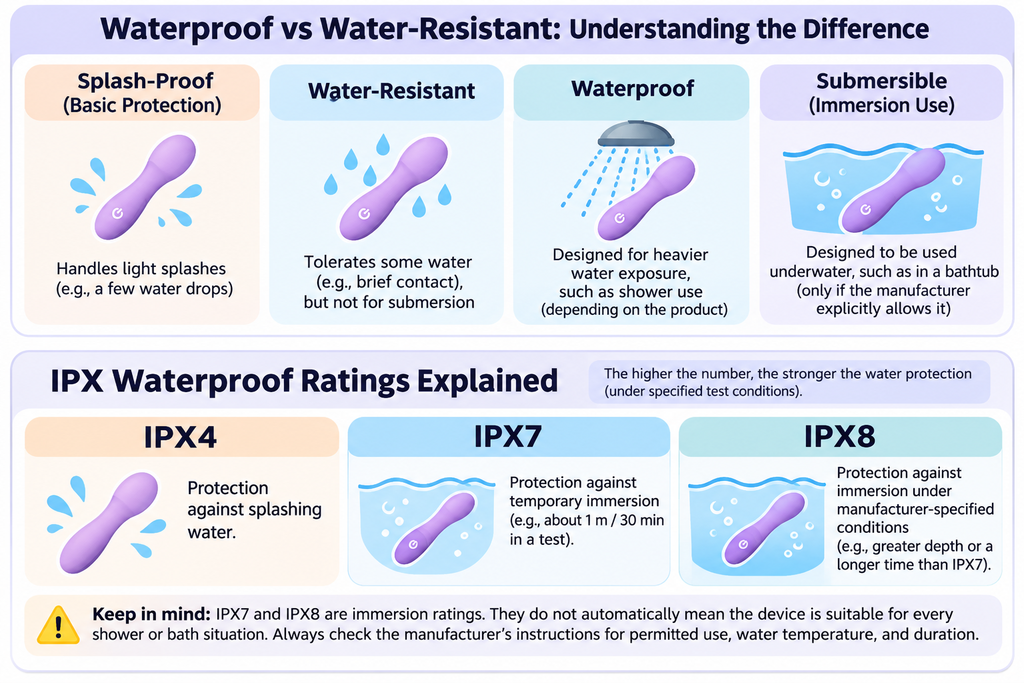
Water-resistant products may tolerate splashes or limited contact with water.
Waterproof products may be designed for shower use, immersion, or both, depending on the manufacturer’s instructions.
However, neither term guarantees unlimited protection.
For a beginner, the most useful distinction is:
- Water-resistant: Usually indicates some protection against moisture or splashes. Do not assume the product can be submerged.
- Waterproof: Suggests stronger water protection, but you still need to check the manufacturer’s stated limits.
- Submersible: Indicates the product is intended to withstand immersion under specified conditions.
- IPX rating: A standardized way to describe protection against water entering an electrical enclosure.
Our recommendation: Choose a product with clear water-resistance specifications and instructions that explicitly permit your intended use.
If you want to use a vibrator in the bathtub, look for an explicit manufacturer statement confirming that the device is suitable for immersion.
If you only need a product that is easy to wipe clean, a fully submersible model may not be necessary.
At a Glance
| Feature | Water-Resistant | Waterproof |
|---|---|---|
| Occasional splashes | May be suitable | Often suitable |
| Shower use | Not automatically permitted | Depends on manufacturer |
| Bathtub immersion | Do not assume it is permitted | Only if explicitly permitted |
| Cleaning under running water | Check instructions | Check instructions |
| Complete submersion | Usually not recommended | Depends on stated limits |
| Charging while wet | Do not charge | Do not charge |
| What to verify | Water exposure limits | Water exposure limits and test conditions |
Important: “Waterproof” and “water-resistant” are broad marketing descriptions. Neither term provides a complete technical specification on its own.
What Does Waterproof Actually Mean?
In everyday conversation, waterproof sounds like a simple promise: water cannot get inside.
In product specifications, the situation is more complicated.
Electronic devices contain components such as motors, circuit boards, batteries, switches, and charging contacts.
If water enters sensitive areas, it can interfere with operation or permanently damage the device.
Manufacturers therefore use different methods to reduce water ingress.
These may include:
- Sealed external housings
- Protective membranes
- Gaskets and seals
- Enclosed electrical components
- Specially designed charging connections
However, a product’s exterior appearance does not reliably tell you how much water exposure it can tolerate.
A vibrator with no visible charging port may still have limitations.
Similarly, a magnetic charging connection does not automatically mean the entire device is waterproof.
Waterproof Does Not Mean Indestructible
Even a properly designed waterproof product can become damaged.
Drops, cracks, worn seals, manufacturing defects, or other physical damage may compromise its protection.
Waterproofing should therefore be understood as a product capability under specified conditions—not a permanent guarantee against every possible type of water exposure.
Does Waterproof Mean Safe for the Shower?
Not necessarily.
An important detail is that water immersion and water spray are different forms of exposure.
A product may be tested for temporary immersion without having been separately tested for water jets.
This distinction becomes clearer when we look at IPX ratings.
Waterproof vs Water-Resistant: Key Differences
For most beginners, the practical differences involve three questions:
How much water can the device tolerate?
A splash-resistant device may be suitable for limited contact with water but unsuitable for immersion.
What type of water exposure is permitted?
Being submerged in relatively still water is not the same as being exposed to a concentrated shower spray.
What does the manufacturer actually allow?
Even when a product carries a water-resistance rating, its instructions may include restrictions involving temperature, cleaning methods, and duration.
Why Marketing Terms Can Be Confusing
Consider two hypothetical products.
Product A
- Described as water-resistant
- Intended to tolerate occasional splashes
- Must not be submerged
- Requires careful cleaning around charging components
Product B
- Described as waterproof
- Manufacturer explicitly permits shower use
- Manufacturer also permits immersion within specified limits
- Must be dried before charging
Product B offers greater flexibility.
However, the comparison only becomes meaningful once you know the actual specifications.
A label saying “100% waterproof” is less informative than clear instructions explaining where and how the product can be used.
Beginner tip: Look for an IP rating or an explicit statement about shower and bath suitability on the manufacturer’s official product page.
Understanding IPX Ratings: IPX4, IPX7, and IPX8
Some vibrators display ratings such as IPX4, IPX7, or IPX8.
These ratings come from the IP Code system described in IEC 60529, an international standard covering protection provided by electrical equipment enclosures.
The system evaluates how well an enclosure protects against the entry of solid objects and water.
What Does IPX Mean?
IP stands for Ingress Protection.
In a designation such as IPX7:
- IP identifies the protection rating system.
- X indicates that no protection grade is specified for solid-particle ingress.
- 7 identifies the water-protection classification.
For example, IP67 and IPX7 both indicate a water-ingress classification of 7.
However, IP67 also specifies a dust-protection classification, while IPX7 does not specify one.
The number tells you about the particular test classification—not every possible condition in which the device can be used.
IPX4: Protection Against Splashes
IPX4 means the enclosure is protected against water splashing from any direction under specified test conditions.
This is useful protection for devices that may encounter occasional splashes.
However, IPX4 does not establish that a product is suitable for immersion.
It also should not be interpreted as automatic approval for sustained exposure to a shower’s direct spray.
If a vibrator is rated IPX4, read the manufacturer’s instructions carefully before bringing it into the shower.
IPX5 and IPX6: Protection Against Water Jets
IPX5 and IPX6 address water projected at an enclosure in the form of jets.
IPX6 uses a more demanding water-jet test than IPX5.
These classifications are worth understanding because shower exposure involves moving water rather than only immersion in still water.
However, a bathroom shower is not identical to a standardized laboratory test.
Water pressure, direction, duration, and temperature can differ.
An IP rating should therefore be considered alongside the manufacturer’s permitted-use instructions.
IPX7: Temporary Immersion
IPX7 describes protection against temporary immersion under standardized conditions.
The commonly cited test involves immersion in water for 30 minutes, with conditions corresponding to approximately 1 meter of water depth.
This does not mean that a device can be left underwater indefinitely.
It also does not guarantee resistance to forceful water jets or unusually hot water.
A product rated IPX7 may be suitable for certain forms of immersion, but its official instructions remain essential.
IPX8: Immersion Under Specified Conditions
IPX8 describes protection against immersion under conditions specified for the particular product.
These conditions are more demanding than the IPX7 immersion test.
However, IPX8 does not correspond to one universal depth or duration that applies to every device.
For example, two IPX8-rated products may have different permitted immersion depths or exposure times.
That is why the rating alone is not enough.
You should look for the manufacturer’s stated test conditions and permitted uses.
Quick IPX Comparison
| Rating | What It Addresses | What It Does Not Automatically Guarantee |
|---|---|---|
| IPX4 | Splashing water | Submersion or shower suitability |
| IPX5 | Water jets | Immersion |
| IPX6 | Powerful water jets | Immersion |
| IPX7 | Temporary immersion | Unlimited immersion or resistance to jets |
| IPX8 | Immersion under specified conditions | Unlimited depth, duration, or water pressure |
Important distinction: IPX7 and IPX8 are immersion classifications. They do not automatically establish compliance with the separate IPX5 or IPX6 water-jet tests.
Is IPX8 Always Better Than IPX7?
Not for every situation.
IPX8 indicates more demanding immersion conditions, but this doesn’t necessarily mean an IPX8 product is better suited to every type of water exposure.
For example, the ability to withstand immersion does not automatically establish resistance to powerful jets.
For everyday use, a clearly documented product that meets your needs may be more useful than one with a higher advertised number but limited supporting information.
The best rating is the one that matches your intended use and is supported by clear manufacturer instructions.
Can You Use a Vibrator in the Shower?
Yes, some vibrators are specifically designed for shower use—but not every waterproof or water-resistant vibrator is automatically suitable.
Before using a device in the shower, check whether the manufacturer explicitly permits it.
What to Check Before Shower Use
1. Look for a clear shower-use statement.
A product page that explicitly says the device can be used in the shower is more useful than a vague description such as “water-friendly.”
2. Check the device’s water-resistance specifications.
If an IP rating is provided, understand what it covers.
3. Check whether accessories are waterproof.
A vibrator may be waterproof while its remote control is not.
4. Keep charging equipment away from water.
Never use a vibrator while it is connected to a charger or electrical power supply.
5. Consider the bathroom environment.
Wet floors and slippery surfaces create additional risks unrelated to the vibrator’s waterproofing.
Are All Parts of a Waterproof Vibrator Waterproof?
No.
This is an important distinction, especially for products with separate remote controls.
For example, We-Vibe’s official FAQ explains that its waterproof devices can be used in the shower, while certain remote controls are not waterproof.
The company also notes that wireless remote control signals may not work properly when a device is submerged.
This illustrates an important buying lesson:
The waterproof specification for the main device does not necessarily apply to the remote control, charging base, or other accessories.
What About Hot Showers?
Water-resistance tests are conducted under specified conditions.
They should not be interpreted as proof that a device will tolerate every water temperature, cleaning chemical, or duration of exposure.
Follow the product’s operating-temperature guidance.
Avoid exposing a device to unusually hot water or prolonged heat unless its instructions explicitly allow it.
Can You Use a Vibrator in the Bathtub?
Only if the manufacturer explicitly permits immersion or bathtub use.
A product that tolerates splashes should not be placed underwater simply because it is described as water-resistant.
For immersion-rated devices, there may still be limits.
These can include:
- Maximum immersion depth
- Maximum exposure duration
- Water-temperature restrictions
- Restrictions involving bath products
- Conditions relating to charging ports or removable parts
Does an IPX7 Rating Mean Bathtub Use Is Always Safe?
No.
IPX7 provides information about a standardized temporary immersion test.
It does not guarantee that every real-world bathtub situation falls within the product’s permitted conditions.
The manufacturer’s instructions should take priority.
Can You Use a Vibrator Underwater?
Some products are designed for underwater use.
However, do not assume that a device’s vibration settings, wireless controls, or other features will operate identically underwater.
Water can interfere with radio-frequency communication.
For example, We-Vibe explains that some of its remote-controlled devices cannot receive remote commands while submerged.
A device may remain protected against water ingress even when its wireless controls are temporarily ineffective.
What About Bath Oils and Bubble Baths?
A product’s water-resistance rating does not necessarily establish compatibility with soaps, bath oils, fragrances, or other chemicals.
These substances may affect materials, coatings, or seals differently from plain water.
If the manufacturer does not provide guidance, avoid exposing the device to concentrated bath products.
Rinse and clean it afterward using the approved method.
Does Waterproof Mean Easy to Clean?
Waterproofing can make cleaning more convenient, but it does not automatically make a product hygienic or easy to maintain.
Waterproofing concerns the protection of the device’s internal components. Hygiene concerns the cleanliness of the surfaces that contact the body.
These are different issues.
A waterproof vibrator may still have seams, textured areas, buttons, or charging contacts that require attention.
A device may also contain materials that need special care.
How to Clean a Waterproof Vibrator
For products whose manufacturers permit washing with water, a typical routine may involve the following steps.
Step 1: Turn the device off.
Disconnect it from any charger or power source.
Step 2: Follow the manufacturer’s cleaning instructions.
Use an approved cleaning method.
For many products, mild soap and water are appropriate, but this is not universal.
Step 3: Clean the external surfaces carefully.
Pay attention to seams, buttons, and textured areas.
Do not force water into openings or removable components.
Step 4: Rinse if permitted.
Remove cleaning residue according to the manufacturer’s directions.
Step 5: Dry thoroughly.
Make sure the device and charging contacts are dry before storage or charging.
How to Clean a Water-Resistant Vibrator
If the manufacturer does not permit rinsing or immersion, use the specified surface-cleaning method.
This may involve gently wiping the device with a suitable damp cloth.
Never assume that a device can be washed under a running tap simply because it is water-resistant.
Can You Boil a Waterproof Vibrator?
No—do not boil a powered vibrator unless the manufacturer explicitly authorizes that method.
Waterproofing does not establish resistance to boiling temperatures.
Heat may damage electronic components, batteries, seals, or surface materials.
Waterproof also does not mean dishwasher-safe.
Does Waterproof Mean Bacteria-Proof?
No.
Waterproofing does not prevent microorganisms from remaining on a product’s surface.
Planned Parenthood recommends cleaning sex toys and following product-specific care instructions.
If a toy is shared, additional hygiene precautions may be needed.
Water protection should never be treated as a substitute for cleaning.
Related Reading
Choosing the right surface material is just as important as understanding waterproofing.
For more information about material differences and cleaning requirements, read:
Silicone vs TPE Sex Toys: Safety, Cleaning, and What to Choose
This companion guide explains how material composition can affect hygiene, maintenance, and everyday care.
What About Charging Ports and Batteries?
Charging is one of the most important safety considerations for electronic products used around water.
A waterproof vibrator must not be assumed to be waterproof while charging.
The main device, charging cable, and charging adapter may have different levels of water protection.
Magnetic Charging Connections
Some vibrators use external magnetic charging contacts.
This can simplify charging, but a magnetic connector does not independently prove that a product is waterproof.
The entire device must be appropriately designed and protected.
USB Charging Ports
Some products use USB charging ports with removable covers or seals.
If the cover is damaged, missing, or not properly closed, the device’s water protection may be compromised.
Check the instructions before exposing the product to water.
Never Charge a Wet Vibrator
Before charging:
- Remove the vibrator from the wet environment.
- Turn it off.
- Clean it if needed.
- Dry the device and charging contacts completely.
- Inspect the charging area for damage.
- Connect the charger only in a suitable dry location.
Never bring a connected charger or mains-powered adapter into the bath or shower.
We-Vibe’s official charging instructions specifically warn users to keep charging units away from water and dry the device before charging.
What If Water Gets Inside?
If a device appears to have suffered water damage, stop using it.
Do not immediately connect it to a charger to see whether it still works.
Contact the manufacturer for guidance.
If a rechargeable battery appears swollen, damaged, unusually hot, or emits an unusual odor, discontinue use and do not attempt to charge it.
How to Choose a Waterproof Vibrator
The right choice depends on how and where you intend to use the device.
Instead of shopping based only on the word “waterproof,” consider the following questions.
1. Where Will You Use It?
Start with the location.
Bedroom or other dry setting
Waterproofing may be useful for cleaning, but it may not be a priority.
Shower
Look for explicit confirmation of shower suitability.
Bathtub
Choose only a product whose manufacturer permits immersion under conditions appropriate for your intended use.
2. Does the Manufacturer Explain the Water Rating?
Look for clear technical information.
An IP rating can be useful, but it should not replace the product’s operating instructions.
If the product claims IPX8 protection, check whether immersion depth and duration are specified.
3. Are the Controls Easy to Use?
A device intended for use in a wet environment should have controls that are practical to operate.
Consider:
- Button size
- Button placement
- Grip and surface texture
- Ability to adjust settings without a separate remote
- Whether a remote is suitable for the intended environment
These features can matter as much as water protection.
4. Is the Product Easy to Clean?
Look for clear instructions covering:
- Surface cleaning
- Rinsing
- Drying
- Charging contacts
- Storage
A product that is difficult to maintain may be inconvenient even if it offers strong water protection.
5. What Is the Product Made From?
Waterproofing and material safety are separate considerations.
For products intended for internal use, clearly identified, non-porous materials are generally preferable.
Check the material specifications rather than relying on a waterproof label.
6. Does the Manufacturer Provide Reliable Support?
A reputable manufacturer should offer:
- Product-specific instructions
- Clear water-use restrictions
- Charging guidance
- Warranty information
- Customer support
If a listing makes broad claims but provides little technical information, consider a different product.
7. Do You Actually Need Full Immersion Protection?
Not everyone does.
A well-made device that is easy to clean and suitable for your intended environment may be a better choice than a more expensive model with features you will rarely use.
Buy for your intended use, not simply for the highest advertised waterproof rating.
Common Waterproof Vibrator Mistakes to Avoid
Mistake 1: Assuming Water-Resistant Means Submersible
Water-resistant does not automatically mean the device can be placed underwater.
Check the official product instructions.
Mistake 2: Treating All Waterproof Claims as Equivalent
Two products described as waterproof may have different testing conditions and permitted uses.
Look beyond the marketing term.
Mistake 3: Assuming IPX7 Covers Every Shower Condition
An immersion rating does not automatically establish resistance to water jets.
Read the manufacturer’s shower-use guidance.
Mistake 4: Bringing the Remote Control Into Water
The main vibrator and its remote may have different water-protection specifications.
Check both.
Mistake 5: Charging Before the Device Is Dry
Moisture around charging connections can create problems.
Keep the charging equipment dry and follow the manufacturer’s instructions.
Mistake 6: Using Excessively Hot Water
A water-resistance rating does not guarantee resistance to every temperature.
Avoid unusual heat exposure.
Mistake 7: Ignoring Surface Damage
Cracks, damaged seals, or other physical deterioration may compromise the device’s protection.
Do not assume that an old or damaged vibrator retains its original waterproof performance.
Mistake 8: Confusing Waterproofing With Hygiene
A waterproof surface still needs appropriate cleaning.
Water resistance does not make a product self-cleaning or eliminate hygiene risks.
Frequently Asked Questions
Can I Use a Water-Resistant Vibrator in the Shower?
Only if the manufacturer explicitly permits shower use.
Water-resistant can describe several levels of protection, so the label alone is insufficient.
Is an IPX7 Vibrator Safe for the Bathtub?
IPX7 indicates protection against temporary immersion under standardized conditions.
Whether a particular vibrator is suitable for bathtub use depends on its manufacturer’s instructions and the conditions involved.
Is IPX8 Better Than IPX7?
IPX8 covers more demanding immersion conditions, but the specific depth and duration vary by product.
It does not automatically mean better protection against every form of water exposure.
Can Waterproof Vibrators Be Used Underwater?
Some can.
However, you should verify that the manufacturer permits underwater operation, not merely that the device has an immersion rating.
Can a Waterproof Vibrator Be Washed Under a Tap?
Often, but not always.
Use only the cleaning method authorized by the manufacturer.
Waterproofing alone does not establish compatibility with every cleaning method.
Are Waterproof Vibrators Easier to Clean?
They can be more convenient to clean because some models tolerate rinsing.
However, seams, surface materials, and other design features still affect cleaning requirements.
Can I Use a Waterproof Vibrator While It Charges?
No.
Do not use a rechargeable vibrator while it is charging unless its manufacturer explicitly authorizes that use—and never use connected charging equipment in a bath or shower.
Are Waterproof Remote Controls Included With Waterproof Vibrators?
Not necessarily.
A waterproof main device may be supplied with a remote control that is only water-resistant or unsuitable for water exposure.
Check each component separately.
Can Waterproofing Wear Out?
A device’s water protection may be compromised by damage, deterioration, or problems with seals and covers.
Regularly inspect the product and stop using it if its integrity is uncertain.
Does Waterproof Mean Safe for Saltwater or Bubble Baths?
No.
Water-resistance ratings do not automatically establish compatibility with saltwater, bath oils, bubble baths, or other substances.
Follow the manufacturer’s instructions.
Final Verdict: Which Should Beginners Choose?
If you want maximum flexibility for cleaning and occasional water exposure, a well-documented waterproof vibrator is often the more practical choice.
However, the word “waterproof” should not be your only buying criterion.
What matters most is whether the product is suitable for your intended use.
If you want to use it in the shower, look for explicit shower-use approval.
If you want to use it in the bathtub, look for clear immersion guidance.
If you primarily use it in dry environments, a water-resistant model with suitable cleaning instructions may be sufficient.
Before buying, remember these five rules:
- Read the manufacturer’s official instructions.
- Understand what the IP rating actually covers.
- Never assume the charger or remote is waterproof.
- Keep charging equipment away from water.
- Inspect and clean the device regularly.
The most useful waterproof vibrator is not necessarily the one with the highest rating or the strongest marketing claim.
It is the one whose water protection, intended use, and care requirements are clearly explained—and appropriate for your needs.
Sources and Further Reading
The following official standards, testing resources, sexual-health guidance, and manufacturer documents were consulted in preparing this article.
1. International Electrotechnical Commission (IEC) — IEC 60529
Degrees of protection provided by enclosures (IP Code).
The international standard defining protection classifications for electrical equipment enclosures.
2. Japan Quality Assurance Organization (JQA) — IP Testing
Information about ingress-protection testing conducted according to JIS C 0920 and IEC 60529.
An overview of water-ingress protection classifications, including splash, water-jet, and immersion ratings.
4. We-Vibe — Frequently Asked Questions
Manufacturer guidance concerning waterproof products, shower use, remote controls, cleaning, and charging.
5. We-Vibe — How Do I Charge My Product?
Manufacturer instructions covering charging connections, keeping chargers away from water, and drying devices before charging.
6. Planned Parenthood — Sex Toys
Sexual-health information about toy materials, hygiene, cleaning, and safer use.
7. International Organization for Standardization — ISO 3533:2021
Sex toys — Design and safety requirements for products in direct contact with genitalia, the anus, or both.
A standard addressing material, design, and user-information requirements for manufactured sex toys.
Note: An international standard’s existence does not establish that every product on the market complies with it.
Editorial Note and Disclaimer
This article is intended for general educational purposes and does not constitute medical, electrical-safety, or professional product-testing advice.
Water-resistance claims, IP ratings, and manufacturer instructions may vary between products and may change over time.
Pleasure Gear Guide has not independently laboratory-tested the waterproof performance of the products or technologies discussed in this article.
Descriptions of IP ratings are based on published technical guidance and should not be interpreted as guarantees of real-world performance.
Always follow the official instructions supplied with your specific device. If those instructions conflict with general advice in this article, the manufacturer’s product-specific restrictions should take priority.
Do not use damaged electronic devices or charging equipment around water. If you suspect water ingress or battery damage, discontinue use and seek appropriate manufacturer guidance.
This article does not contain independent hands-on product testing or paid product endorsements.